
BY MARILYNN HUGHES
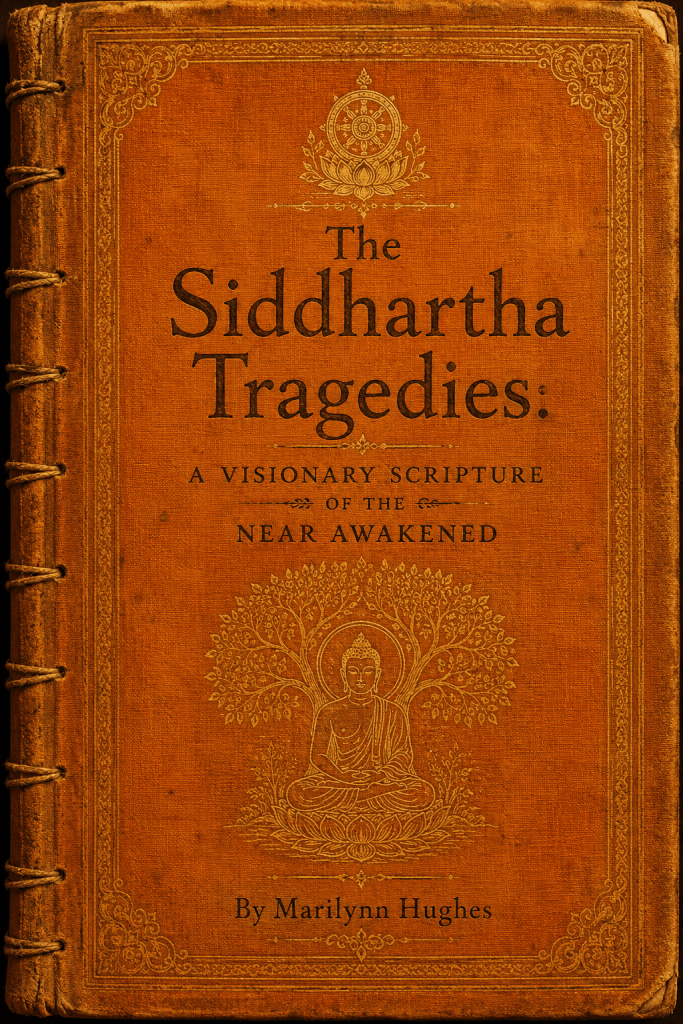
The Siddhartha Tragedies: A Visionary Scripture of the Near Awakened
By Marilynn Hughes
There are texts that describe enlightenment.
And there are texts that describe the one who is seeking it.
This is neither.
The Siddhartha Tragedies is a manuscript said to exist in a scriptorium where only unfinished lives are recorded—lives that never fully resolve into history, yet continue to unfold wherever consciousness mistakes itself for a separate seeker.
Across three movements—lived incarnations, symbolic parables, and threshold revelations—the same pattern repeats in different forms: awakening approached, refined, delayed, misunderstood, and finally recognized as something that was never truly elsewhere.
A prince who does not return to innocence.
An ascetic who discovers discipline can become identity.
A teacher whose clarity outpaces compassion.
A savior who learns that even compassion can become structure.
A beloved life that quietly closes the need to seek.
An awakening that cannot stabilize within the world of form.
And a final thread that refuses to dissolve even after everything else has been released.
But as the manuscript unfolds, the distinction between reader and subject begins to erode.
The lives described do not accumulate into biography.
They converge into recognition.
Not of Siddhartha.
But of the mechanism through which any “Siddhartha” is imagined at all.
By the time the final page is reached, nothing definitive is offered.
Only a quiet suggestion that the tragedy was never located in a single life, or a single name—but in the assumption that there was someone moving through them in the first place.
Reviews
“I recently came across The Siddhartha Tragedies: A Visionary Scripture of the Near Awakened and was particularly captivated by its imaginative and philosophical approach to one of spirituality’s deepest inquiries: the nature of the seeker itself. What makes the book especially intriguing is that it appears to move beyond traditional narratives of enlightenment and instead explores the recurring patterns through which awakening is pursued, deferred, misunderstood, and ultimately recontextualized. I was especially drawn to the manuscript’s structure, where multiple lives and archetypal journeys converge not into biography, but into an examination of consciousness and the assumptions that sustain the search for selfhood. The progression from lived incarnations to symbolic parables and threshold revelations creates a rich contemplative framework that invites readers to question familiar distinctions between seeker and sought, subject and object, self and awakening. Particularly compelling is the suggestion that the central tragedy is not found in any individual life story but in the deeply ingrained belief that there is a separate entity moving through those stories. By blending mystical symbolism, existential inquiry, and non-dual themes, the book offers readers a thought-provoking exploration of identity, recognition, and the paradoxes that emerge on the path toward spiritual realization.” – Manu Kanwarpal, Reader, Pursuit of Spirituality Book Club, USA

