
Wonderment, Devotion and Humility Through the Tripitaka
BY MARILYNN HUGHES
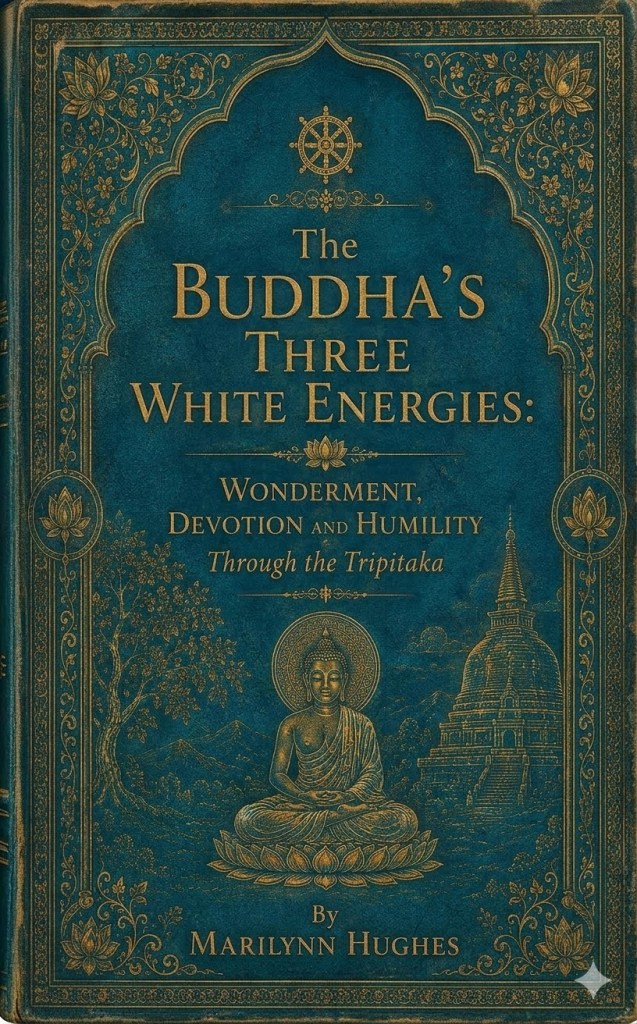
The Buddha’s Three White Energies: Wonderment, Devotion and Humility Through the Tripitaka
By Marilynn Hughes
The Buddha’s Three White Energies: Wonderment, Devotion and Humility Through the Tripitaka, By Marilynn Hughes – AN UNBIASED TEXTBOOK ENCOUNTER WITH THE BLISSFUL SOURCEThis groundbreaking text stands as a definitive phenomenological exploration into the very bedrock of spiritual liberation. Grounded entirely in a profound, unedited mystical encounter in which the Buddha directly initiated author Marilynn Hughes into the core vibrational frequencies of the cosmos, this volume bridges direct experience with the ancient canonical architectures of Eastern spirituality. Moving far beyond abstract philosophical speculation, the text traces a systematic deconstruction of the lowercase ego. It uncovers how three foundational currents—Wonderment, Devotion, and Humility—function as an energetic engine designed to cleanse the subtle anatomy and dissolve the conceptual illusions of the third dimension. Through this independent textbook commentary, these pure states of being are revealed not as doctrine, but as lived modes of operational perception that gradually unveil the deep, unyielding structure of reality itself. Map the Experiential Anatomy of Buddhist Canonical Practice: • The Energy of Wonderment: Discover how sacred awe, intense curiosity, and the arrest of the everyday mind fracture sensory mechanics, opening the consciousness to higher spiritual perceptions. • The Energy of Devotion: Examine the high-vibrational current of total spiritual surrender, mapping how single-pointed focus to the uncreated reality completely clears the subtle channels of egoic agitation. • The Energy of Humility: Dissect the ultimate psychological and metaphysical purge, where the systematic lowering of self-importance triggers a profound internal vacuum, allowing awareness to merge with the Infinite. A Flawless Synthesis of Scripture and Direct Phenomenological Sight: • The Sutta Piṭaka: Early discourses utilized as resonant, objective confirmations of what is directly encountered within consciousness when it is no longer organized around fixation. • The Vinaya & Abhidhamma: The disciplinary frameworks and analytical clarity of the Pali Canon integrated as precise blueprints for internal energetic stabilization. • Mahāyāna Thought: Expansive insights weaving themes of impermanence, non-self, emptiness, and suchness (tathātā) into a reflective narrative of experiential unfolding. The culmination of this scholarly reference work is not a conclusion, but a radical return: to ordinary experience seen entirely without distortion, where nothing is excluded from awareness, and nothing requires separation in order to be known. This is an essential textbook for serious researchers of global world religions, comparative mysticism, and the direct phenomenological exploration of consciousness. Elevate your master reference library and secure this foundational volume in your collection today.
Reviews
“Dividing spiritual dissolution of the ego into exactly three currents, wonderment, devotion, and humility, and then mapping each one onto specific sections of the Pali Canon rather than leaving the framework abstract, is a genuinely unusual structural choice for a book this compact. Most writing in comparative mysticism either stays in the territory of direct experience or stays in the territory of scholarship, rarely trying to hold both at once with this much precision. Grounding wonderment in the arrest of ordinary sensory mechanics, devotion in the clearing of the subtle channels through single pointed focus, and humility in what you describe as a systematic lowering of self importance that opens awareness toward the infinite, gives each of these three states its own distinct mechanism rather than treating them as interchangeable virtues. Weaving in the Sutta Pitaka, the Vinaya and Abhidhamma, and Mahayana concepts like emptiness and suchness as points of confirmation for what you describe encountering directly, rather than as separate scholarly material bolted onto a personal account, is a difficult synthesis to pull off convincingly, and it reflects the same disciplined approach that has run through your work since 1987.” – Demyte Nathan, Luminary Agency, Ottawa Ontario, CN

