W26 THE GLOBAL DISCLOSURE PROJECT LAUNCHES ITS INTERNATIONAL CROWDFUNDING CAMPAIGN

Woman holding a smartphone overlooking a city skyline at night with text reading “The Global Disclosure Project.”

PRESS RELEASE · 19 November 2026 · For immediate release

W26 THE GLOBAL DISCLOSURE PROJECT LAUNCHES ITS INTERNATIONAL CROWDFUNDING CAMPAIGN

Led by Roberto Pinotti, sociologist, aerospace journalist and former SETI consultant, who founded CUN, the Centro Ufologico Nazionale, in 1967 and, in 2021, ICER, the International Coalition for Extraterrestrial Research, which brings together researchers from 27 countries and which he chairs, THE W26 PROJECT asks the public to fund one archive for the world’s UFO evidence and one shared international database. Thirty-two of the most authoritative researchers, scientists and authors from around the world sit on its Board of Custodians. The goal is €1,000,000.

[Planet Earth], 19 November 2026. W26 The Global Disclosure Project opens today its international crowdfunding campaign on Campagna Crowdfunding: https://www.campagnacrowdfunding.com/c/w26

Created by Roberto Pinotti with Avi Loeb (Frank B. Baird Jr. Professor of Science, Harvard University; Chair of the UAP Science Council; Director of the Galileo Project, United States) Whitley Strieber (Author of the international bestseller “Communion”, United States) Christopher Mellon (Chairman of the Board of the Disclosure Foundation; former U.S. Deputy Assistant Secretary of Defense for Intelligence, United States) Javier Sierra (International bestselling writer and journalist, published in 45 countries, Spain) Stephen Bassett (Political activist, Paradigm Research Group, United States) Eric W. Davis (Astrophysicist, EarthTech International, United States) Donald Schmitt (CUFOS investigator, member of the Board of the Roswell Museum and best-selling author, United States) Jean-Jacques Velasco (Former head of GEPAN/SEPRA, France’s official UAP office, France) Philip Mantle (Author and publisher, Flying Disk Press, United Kingdom) Erling Strand (Co-founder, Project Hessdalen, Norway) Thiago Ticchetti (Ufologist, Editor of Revista Fenômeno OVNI magazine and National Director of MUFON in Brazil) Clas Svahn (Chairman for Archives for the Unexplained, Sweden, and international director for UFO-Sweden)

The goal of W26 is one archive for the world’s UFO evidence, one shared international database and one independent research observatory, funded by the people and owned by no one.

For almost eighty years the UAP phenomenon has challenged humanity, yet the data remain fragmented, classified or scattered: archives at risk of being lost, isolated research, filtered information. W26 starts from the idea that disclosure will not arrive as a concession from governments, but has to be built from the ground up. The project aims to unite people, organisations and researchers from every country in a single free and transparent infrastructure.

WHAT THE FUNDS WILL BE USED FOR

The goal is €1,000,000. The project is built in four modules, carried out in order as the funds come in, over a period of 365 days. The next module starts when the previous one is funded.

  1. Saving and digitising the world’s archives (11%, €110,000): documents, photographs, film and long-unobtainable books held by individuals and associations, secured, digitised and made public on w26.it, starting with Roberto Pinotti’s archive.
  2. One unified database (16%, €160,000): one scientific scheme for the cases of the past and every new sighting as it comes in, with open software and a public interface for researchers and associations.
  3. Reasoned disclosure (14%, €140,000): all the information, images, videos and documents on a single public timeline, from prehistory to today, and a documentary film with the Custodians.
  4. The two Mother Centres and the national task forces (59%, €590,000): two centres with laboratories, observatories and conference halls, and instrument kits for the task forces of every country in the network.

If the campaign goes beyond the goal, the four modules grow in the same proportions. Whatever the total, every promised reward is delivered. The full breakdown is at https://www.w26.it/funds/

THE BOARD OF CUSTODIANS

The Board of Custodians (Consilium Custodum) gathers 32 internationally renowned figures in the field, appointed for life to a limited number of non-renewable posts. The Custodians have full access to the archives, the global database and the research centres, and act as their guardians.

In alphabetical order by surname:

  • Eamonn Ansbro, Astronomer, Kingsland Observatory (Ireland)
  • Stephen Bassett, Political activist, Paradigm Research Group (United States)
  • Alfredo Benni, ICT Manager and Project Manager, researcher (Italy)
  • Eric W. Davis, Astrophysicist, EarthTech International (United States)
  • Robert Fleischer, Founder of ExoMagazin.tv (Germany)
  • Rodrigo Fuenzalida, Leading figure of Chilean ufology (Chile)
  • Sheryl Gottschall, President of UFO Research Queensland (Australia)
  • Gerhard Gröschel, Founder of ITUF, the Institute for Technical UFO Research (Germany)
  • José Guijarro Triado, UFO researcher, writer and journalist; Director of EspacioMisterio.com (Spain)
  • Jann Halexander, Singer-songwriter and actor, founder of UAP Africa (France/Gabon)
  • Gary Heseltine, Editor of UFO Truth Magazine (United Kingdom)
  • Dave Hodrien, Chairman and Lead Investigator for Birmingham UFO Group (United Kingdom)
  • Avi Loeb, Frank B. Baird Jr. Professor of Science, Harvard University; Chair of the UAP Science Council; Director of the Galileo Project (United States)
  • Philip Mantle, Author and publisher, Flying Disk Press (United Kingdom)
  • Christopher Mellon, Chairman of the Board of the Disclosure Foundation; former U.S. Deputy Assistant Secretary of Defense for Intelligence (United States)
  • Francisco Mourão Corrêa, Researcher at CTEC, Fernando Pessoa University; Founder of ICER; Coordinator of STELLAR; Director at SUAPS (Portugal)
  • Tim Murithi, Professor of African Studies, University of the Free State and Stellenbosch University; South African representative to ICER (South Africa)
  • Fred Pallesen, Project Hessdalen (Norway)
  • Andrea Pérez Simondini, Continental Director for South America of ICER, Director of CEFORA, the Argentine Commission for the Study of the UFO Phenomenon, and Director and Curator of the UFO Museum in Victoria, Entre Ríos (Argentina)
  • Giorgio Piacenza, Sociologist and ufologist (Peru)
  • Roberto Pinotti, Founder of CUN, Centro Ufologico Nazionale; Founder of ICER, The International Coalition for Extraterrestrial Research (Italy)
  • Donald Schmitt, CUFOS investigator, member of the Board of the Roswell Museum and best-selling author (United States)
  • Javier Sierra, International bestselling writer and journalist, published in 45 countries (Spain)
  • Ananda Sirisena, Sri Lanka President of the Society for Planetary SETI Research (Sri Lanka/United Kingdom)
  • Albert So, President of the Hong Kong UFO Club (Hong Kong)
  • Roger Stankovic, Former neuroscientist at the University of Sydney, National Director of MUFON Australia & New Zealand (Australia)
  • Erling Strand, Co-founder, Project Hessdalen (Norway)
  • Whitley Strieber, Author of the international bestseller “Communion” (United States)
  • Clas Svahn, Chairman for Archives for the Unexplained and international director for UFO-Sweden (Sweden)
  • Thiago Ticchetti, Ufologist, Editor of Revista Fenômeno OVNI magazine and National Director of MUFON in Brazil (Brazil)
  • Adrian Urzică, Executive Director of ASFAN România (Romania)
  • Jean-Jacques Velasco, Former head of GEPAN/SEPRA, France’s official UAP office (France)

Together with the College of Legates, the communicators and researchers who carry the work of W26 to the wider public, and the Consulta, made up of supporters of the campaign who take part in the project’s consultations, the Board forms the Convivium W26, which speaks through numbered advisory opinions, the Responsa.

The Legates, in alphabetical order by surname:

  • Amber Amrhein (United States)
  • Joe Biscotto (United States)
  • Rowan Bo (Australia)
  • Jimmy Carbone (England)
  • Reverend Stuart Cardell (Australia)
  • Adriana Castro (Brazil)
  • Ross Coulthart (Australia)
  • Preston Dennett (United States)
  • Frank Elyas (Taiwan)
  • Karen Endsley (United States)
  • Darío A. Fernández (Argentina)
  • Lars A. Fischinger (Germany)
  • Ben Freeman
  • Jeremy Golden (United States)
  • Dan Harary (United States)
  • Harald Havas (Austria)
  • Sean Patrick Hazlett (United States)
  • Sazzad Hossain (Bangladesh)
  • Marilynn Hughes (United States)
  • Johnny (Japan)
  • Rahat Jubaer (Bangladesh)
  • Desoray Kencayd (Canada)
  • J. Gustavo Kurczyn Cortés (Mexico)
  • Elle Lectrick (United States)
  • Francisco Javier Losada (Spain)
  • Maetel (Japan)
  • Vanca Mansell (Canada)
  • Sofia Marchetti (Brazil)
  • Kory Moo (United States)
  • Nicolle Morock (United States)
  • Nabila (Mexico)
  • Adrián H. Nicala (Argentina)
  • Richard Ethan Oates (United States)
  • Michael Parker (United States)
  • Sarah Powell (United Kingdom)
  • Morgan Priest (France)
  • RIKEOKA Ino (Japan)
  • Wladislaw Raab (Germany)
  • Michael J. Riso
  • Benoit Rivaux (Malta)
  • Will Rodriguez (United States)
  • Sai Vignesh K (India)
  • Bill Sego (United States)
  • Duke Sullivan (United States)
  • Micaela Superstar (United States)
  • Dr. Gábor Tarcali (Hungary)
  • Martin Willis (United States)
  • Monica Walston (United States)
  • Jo Wood (United Kingdom)
  • D.ZOMBIE (Japan)

HOW THE CAMPAIGN WORKS

W26 adopts the reward-based model: supporters receive a tangible sign of belonging to the project. The rewards form a ladder, and each level includes everything below it. They start at €30, W26 Founder Signal, with your name in Record Zero on w26.it, and go up to W26 Founder President, €9,000, limited to 26 seats, with an entire archive carrying your name and your name in the founding acts of the Foundation. Stand-alone rewards include the book “W26, The Global Disclosure Project” (€25) and a ticket to the online World Conference of April 2027. The full list is on the campaign page.

The campaign follows the “Keep it All” model: the funds go to the Committee’s account as they are raised, even if the goal is not reached. Payments are made by card and handled by Stripe.

Campaign goal: €1,000,000 Campaign closes: 19 November 2027

TRANSPARENCY (visit: https://www.w26.it/funds/ )

W26 is run by a non-profit Committee established under articles 39-42 of the Italian Civil Code and chaired by Roberto Pinotti. Under that law the funds raised are bound to the declared purpose and cannot be diverted elsewhere. The Committee’s treasurer is not a family member of the president, and an independent auditor oversees the accounts. Every three months the Committee publishes on w26.it the state of each module and the use of the funds.

I am 82 years old and I have dedicated my whole life to UFO research, together with many of the researchers and scientists who are with me today in the W26 project.

We know very well that many private archives risk disappearing along with their owners, as has already happened in the past.

From the safeguarding of these archives, a far more ambitious project was born: to unite world ufology, to create a great shared archive and a worldwide database built on scientific criteria and, as a result, to give life to a disclosure from the ground up which, we are certain, will bring several surprises to the public.

With one year of fundraising, we expect to raise enough funds to create two independent research centres, with laboratories and observatories, and task forces in every country.

Today, 29 countries on every continent are involved.

This is a great handover from my generation to the younger ones.

Become a founder of this project at https://www.campagnacrowdfunding.com/c/w26

Roberto Pinotti Sociologist, aerospace journalist and former SETI consultant. He founded CUN, the Centro Ufologico Nazionale, in 1967 and, in 2021, ICER, The International Coalition for Extraterrestrial Research, which brings together researchers from 27 countries. He has published 72 books in 7 languages over sixty years of documented research.

ABOUT CAMPAGNA CROWDFUNDING

Campagna Crowdfunding is an Italian reward-based crowdfunding platform, run by Kijo Digital SRLS. It supports project creators in preparing their campaign, from the audience analysis to the copy, the rewards and the images, and in promoting it by email and on social media. https://www.campagnacrowdfunding.com/en

LINKS

W26 campaign: https://www.campagnacrowdfunding.com/c/w26 W26 website: https://www.w26.it Where the money goes: https://www.w26.it/funds/ The Convivium and the Board of Custodians: https://www.w26.it/convivium/ Campagna Crowdfunding: https://www.campagnacrowdfunding.com/en

PRESS CONTACTS

For interview requests and information: press@campagnacrowdfunding.com, postmaster@robertopinotti.com, w26project@gmail.com

To book an interview with Roberto Pinotti, please visit https://www.w26.it/press/

W26 The Global Disclosure Project Committee established under articles 39-42 of the Italian Civil Code Italian tax code 93061690165


Discernment, Judgment, and Deliverance: Further Reflections on Purification from An Unpublished Manuscript on Purgatory

Winged angel in ornate armor guiding a woman through a glowing church doorway

By Marilynn Hughes

In this second part of my reflection on An Unpublished Manuscript on Purgatory by Sister Mary of the Cross, I wanted to explore the deeper mystical mechanics preserved inside those sixteen years of convent notebooks. Across decades of out-of-body travel and comparative sacred study, I have found that the second half of this 19th-century record offers some of the clearest, most practical lessons ever recorded on spiritual discernment, the moment of transition, the active mission of St. Michael the Archangel, the dangers of spiritual curiosity, and the ultimate release of the soul.

1. The Mechanics of the Manifestations and Testing the Spirit

One of the most instructive aspects of Sister Mary of the Cross’s account is how carefully she documented both the physical manifestations and the spiritual safeguards surrounding them. Before any words were ever spoken in February 1874, she experienced months of audible, sorrowful sighs beside her in the convent, the distinct sensation of an unseen presence, and interior locutions. Rather than naively accepting every unexplained phenomenon at face value, she immediately placed herself under the direction of her confessor, who instructed her to test the spirit rigorously. In mystical theology, just as in astral projection, lower or deceiving entities frequently impersonate departed souls to feed on human vanity or fear. Sister Marie-Gabrielle proved her authenticity not through sensational claims, but through radical humility, obedience to spiritual authority, and a singular focus on penance and love of God.

2. The Moment of Death, the Particular Judgment, and St. Michael’s Role

Throughout their dialogues, Sister Marie-Gabrielle offers a penetrating account of what occurs at the exact threshold of physical death—and highlights the extraordinary, active mission of St. Michael the Archangel. She explains that the instant the soul separates from the physical body, every earthly illusion and self-justification vanishes completely. In a single flash of divine light, the soul perceives its entire life—every hidden motive, omission, and act of love—in the presence of St. Michael, whom she describes as the one heavenly figure every soul sees upon leaving the body. Far surpassing even our Guardian Angels in celestial beauty, St. Michael stands at the Particular Judgment and personally conducts the soul to the exact degree of purification it requires. Crucially, she testifies that God does not have to force an imperfect soul into Purgatory; seeing its own stains against the blinding purity of divine love, the soul itself recoils from entering Heaven unpurified and willingly embraces the cleansing spheres. St. Michael continues to visit Purgatory alongside the Blessed Virgin Mary, speaks with the souls about Heaven, liberates multitudes on his feast day—especially those who honored him during life—and personally escorts each purified soul into the presence of God once its exile is complete.

3. The Warning Against Idle Curiosity and Spiritual Pride

A vital teaching woven through the later years of the manuscript—and one every modern seeker should take to heart—is Sister Marie-Gabrielle’s firm refusal to indulge human curiosity. Whenever questions drifted toward speculation about the future, hidden secrets, or the eternal fate of other individuals, she gently but firmly refused to answer. She reminded Sister Mary of the Cross that God only permits contact between the departed and the living for the purification and salvation of souls, never to satisfy intellectual curiosity or flatter spiritual pride. Furthermore, she warned that consecrated souls and those granted abundant spiritual light on earth face a far stricter purification if they cling to subtle vanity, self-will, or concern for their own reputation.

4. Her Final Deliverance on All Souls’ Day (November 2, 1890)

The sixteen-year narrative arc reaches a quiet, luminous conclusion on November 2, 1890—All Souls’ Day. After years of shared prayer, Eucharistic adoration, Ways of the Cross, and quiet sacrifice offered by Sister Mary of the Cross, Sister Marie-Gabrielle’s purification was finally complete. She appeared one last time to bid farewell and express her deep gratitude, promising that from Heaven she would faithfully intercede for her companion and for all the living souls whose prayers and Masses had hastened her entry into the Beatific Vision.

Taken together with the first part of her testimony, these closing lessons remind us that the veil between the visible and invisible worlds is far thinner than we realize—and that genuine spiritual contact always calls us toward deeper humility, vigilance, and charity for those who have gone before us.

Lessons from Beyond the Veil: Revisiting An Unpublished Manuscript on Purgatory by Sister Mary of the Cross

Nun writing in a large manuscript by candlelight inside a medieval stone room

By Marilynn Hughes

When a beloved member of our Out-of-Body Travel Foundation community recently reached out to ask about An Unpublished Manuscript on Purgatory by Sister Mary of the Cross (originally recorded in French by Sister Marie de la Croix, or Sister M. de L. C.), it brought back vivid memories of studying this remarkable little volume several years ago. Across decades of out-of-body travel, comparative mystical research, and examining ancient sacred texts, certain accounts stand out not for theatricality, but for their sober, unflinching clarity regarding what awaits the soul after physical death. This 19th-century convent record is undeniably one of them.

The Historical Context and the Sixteen-Year Dialogue

The origins of the text are rooted in quiet monastic life in Valognes, Normandy, France. In November 1873, Sister Mary of the Cross began hearing prolonged, sorrowful sighs right beside her in the convent. Initially frightened, she multiplied her prayers, Rosaries, and Ways of the Cross, pleading with the unseen presence not to show itself. Three months later, on February 15, 1874, a recognizable voice finally spoke to her, identifying herself as Sister Marie-Gabrielle—a fellow nun who had passed away at the age of thirty-six on February 22, 1871.

What makes their exchange so deeply instructive for students of spiritual law is why Sister Marie-Gabrielle was permitted to return to Sister Mary of the Cross. During her earthly life, Sister Marie-Gabrielle had frequently rejected and despised the spiritual counsel of this very sister. In the economy of divine justice and mercy, God allowed her to return from Purgatory to the exact companion she had once dismissed, both to seek her prayers and sacrifices for deliverance and to offer rigorous spiritual direction drawn from her own painful purification. For sixteen years, from 1874 until 1890, Sister Mary of the Cross faithfully transcribed these conversations in her notebooks, which were later examined by Catholic theologians and granted formal ecclesiastical approval (Nihil Obstat and Imprimatur) as an edifying historical testimony.

The Three Realms of Purification

One of the most compelling aspects of the manuscript—and one that aligns closely with broader mystical accounts of the intermediate spheres—is Sister Marie-Gabrielle’s firsthand cartography of Purgatory. Having passed through its degrees herself, she describes Purgatory not as a single uniform room, but as a tiered state of purification divided into three primary levels:

  • The Great Purgatory (The Lowest Level): Located near the center of the earth close to Hell, this deepest stage consists of several degrees of intense fire and profound darkness. Here reside souls who committed grave sins during life and were saved almost miraculously at the final moment through last-minute contrition—often won through the persistent prayers of pious parents or loved ones. In this lowest tier, souls are deprived of any vision of the Blessed Virgin Mary and endure what Sister Marie-Gabrielle calls a temporary hell of acute torment.
  • The Second Level: This realm holds souls who died with unexpiated venial sins, forgiven mortal sins for which full satisfaction had not yet been made, or long years of spiritual indifference and tepidity. Here the suffering is less severe than in the abyss below, and souls are granted occasional, consoling glimpses of the Blessed Mother. Notably, Sister Marie-Gabrielle emphasizes a sobering truth echoed across mystical theology: consecrated souls, priests, and those who received abundant spiritual graces on earth undergo a much longer and stricter purification here than ordinary laypeople, because far more was entrusted to them.
  • The Purgatory of Desire (The Threshold): The highest stage contains no purifying fire at all. Instead, its martyrdom is purely interior—an insatiable, agonizing longing for the Beatific Vision of God while remaining held back by subtle residual imperfections. As Sister Marie-Gabrielle explains, very few souls escape this threshold, because avoiding it entirely requires an ardent, consuming desire for Heaven and complete detachment from earthly self-will prior to death.

Key Spiritual Takeaways for Seekers Today

Beyond its structure of the afterlife, An Unpublished Manuscript on Purgatory reads as a manual on interior purification and the power of intercession. Several core teachings from Sister Marie-Gabrielle’s dialogues remain profoundly relevant for anyone walking a serious contemplative path:

  • The Deprivation of God Is the True Torment: While the lower spheres involve searing purification, the manuscript insists that the supreme agony of Purgatory is the absence of God—knowing Him with crystal clarity after death, yearning for Him with the full weight of the soul, and realizing that one’s own unpurified attachments are what bar the door.
  • Time Beyond the Body: Sister Marie-Gabrielle notes that while earthly calculations might place an average stay at thirty or forty years—and longer for negligent consecrated souls—time is experienced entirely differently outside the body. Having been in Purgatory for eight earthly years at the time of one dialogue, she remarked that it felt to her like ten thousand.
  • The Power of the Living to Relieve the Dead: Souls in Purgatory have their wills completely united to God, yet they are powerless to merit relief for themselves; they depend entirely on the charity of the living. Throughout the sixteen years of visits, Sister Marie-Gabrielle repeatedly testifies to the extraordinary power of the Holy Mass, Eucharistic adoration, and the Way of the Cross to shorten a soul’s exile, adding that God frequently grants immense graces to the living through the grateful intercession of the Holy Souls they help release.
  • Self-Renunciation and Present Vigilance: Perhaps her most urgent counsel to Sister Mary of the Cross—and to every reader—is to live entirely for God in the present moment rather than clinging to earthly reputation, personal comforts, or self-will. As she warns in one of the manuscript’s most memorable passages, everything on earth passes swiftly, and only what is done in pure love for God endures into eternity.

For anyone studying the mechanics of the afterlife, the purification of the soul, or the communion between the living and the departed, An Unpublished Manuscript on Purgatory remains a deeply sobering and luminous read—one that invites us to purify our intentions today rather than waiting for the fires of tomorrow.

Both Saint and Man: Reflections on Reading Volume IV of the Letters of Padre Pio

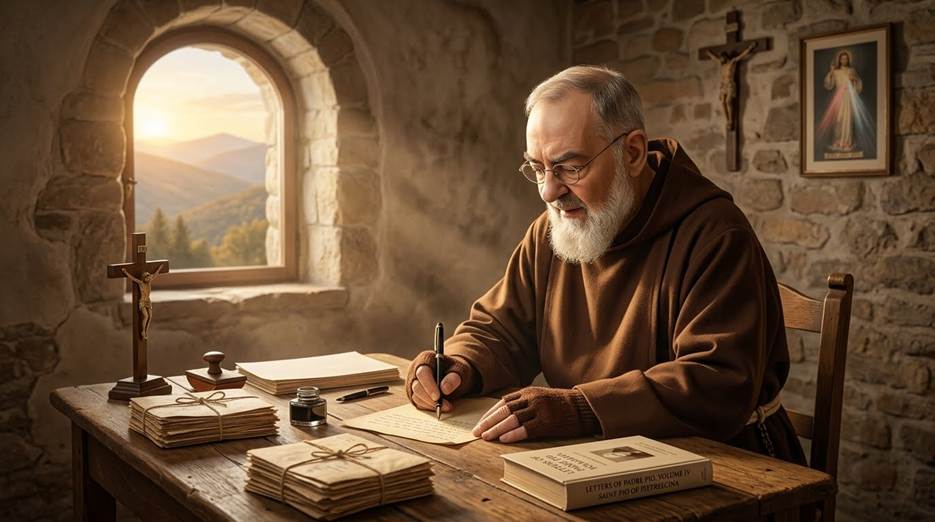
Bearded monk writing at a wooden desk in a stone chapel with a crucifix, religious books, and a mountain view through the window

By Marilynn Hughes

Lately, I have been making my way through Padre Pio’s Letters, Volume IV, the final volume in the English translation of Saint Pio of Pietrelcina’s correspondence which was recently released. While the earlier volumes focus largely on his intense mystical experiences shared with his spiritual directors or his detailed direction of specific spiritual daughters, this fourth volume opens a wider, wonderfully human window into his life. Gathering letters written to his own family members, fellow Capuchin friars, priests, bishops, popes, and ordinary laypeople seeking comfort—alongside essays from the early years of his priesthood—it reveals Padre Pio not only as a towering mystic, but as a devoted son, a loyal friend, and a deeply practical shepherd of souls.

The Missing Bridge Between Mysticism and Daily Life

What makes this fourth volume so compelling is how it bridges the gap between Padre Pio’s hidden interior life and his everyday interactions with the world around him. In these pages, you see him writing with tender affection and humility to his father, Grazio, who was working in America to support the family—including a touching letter in which a young Padre Pio apologizes for spending money on a pilgrimage to Pompeii before entering the friary. You see him corresponding with Church leaders and fellow friars, offering institutional support, charitable concern, and quiet obedience even during seasons when he was restricted from celebrating public Mass.

At the same time, you glimpse his unmistakable firmness when defending the Church he loved. When a well-meaning acquaintance planned to publish a book criticizing the clergy over the restrictions placed upon Padre Pio, the saint did not hesitate to reproach him directly, refusing to let loyalty to him become a weapon against ecclesial unity. Reading these letters side by side reminds you that genuine holiness never detaches a person from human responsibility, family gratitude, or loyalty to the wider community of faith.

Practical Wisdom for Ordinary Struggles

For anyone picking up this volume today, the letters to ordinary men and women facing illness, grief, doubt, and family worries feel remarkably immediate. Padre Pio never wrote abstract theology from an ivory tower; he wrote to real people carrying real crosses, offering spiritual guidance that balanced bracing clarity with deep, fatherly warmth.

Across this correspondence, several timeless threads stand out:

  • Trust Over Anxiety. Again and again, Padre Pio urges his correspondents to lay down restless worry and abandon themselves to Divine Providence, reminding them that turmoil of spirit only clouds the soul’s peace.
  • Patience in Trial. Rather than promising easy escapes from suffering, he consistently teaches that endurance, daily fidelity, and quiet acceptance unite our small trials to the Cross of Christ.
  • Firmness Rooted in Tenderness. Whether encouraging a discouraged soul or gently correcting someone drifting into spiritual extremes, his words carry the unmistakable tone of a spiritual father who genuinely cares for the eternal good of the person holding the letter.

A Companion for Quiet Reflection

One of the joys of reading Letters IV is that you do not even have to read it straight through from cover to cover like a conventional biography. Because each letter was written as a personal response to a specific human heart, opening to almost any page feels like sitting down in a quiet room and receiving a word of counsel meant for that exact moment. Closing the book after each sitting, what lingers most is how seamlessly the extraordinary and the ordinary lived together in Padre Pio—showing that the path to sanctity is walked one faithful, compassionate, and honest letter at a time.

A Hidden Life Revealed: Reflecting on The Life of Sr. Mary Wilhelmina

Sister Mary Wilhelmina - Portrait of a nun wearing a black-and-white habit and glasses

By Marilynn Hughes

Lately, I have been reading The Life of Sr. Mary Wilhelmina, the biography written by the sisters of her own community, the Benedictines of Mary, Queen of Apostles. While many people around the world first heard of Sister Mary Wilhelmina Lancaster in 2023 through headlines about the remarkable preservation of her body four years after her death, reading through her sisters’ account reveals something even deeper: a woman whose ninety-five years on earth were defined by quiet perseverance, poetic joy, and an unshakable fidelity to her religious vocation.

Early Years and a Lifelong Vocation

Born Mary Elizabeth Lancaster on Palm Sunday, April 13, 1924, in St. Louis, Missouri, she grew up in a devout Catholic family as a descendant of enslaved ancestors. From a very young age, she felt drawn to religious life, even experiencing childhood moments of deep prayer and spiritual awareness that stayed with her throughout her life. In 1941, at just seventeen years old, she entered the Oblate Sisters of Providence in Baltimore—the first successful religious order established in the United States for women of African descent—taking the religious name Sister Mary Wilhelmina of the Most Holy Rosary.

For more than five decades, Sister Mary Wilhelmina served faithfully as a teacher and mentor, dedicating her life to educating children in inner-city schools across the country. Those who knew her during those years remembered her sharp wit, her love for writing poetry, and her deep, steady devotion to the Eucharist and the Blessed Virgin Mary. Navigating the realities of segregation and racial tension both in society and within religious institutions, she remained anchored in her identity in Christ, famously expressing that above every earthly distinction, belonging to God was everything.

A Bold New Chapter at Age Seventy

As decades passed and religious communities underwent sweeping changes in the late twentieth century, Sister Mary Wilhelmina felt a persistent call toward traditional monastic life—specifically the full traditional religious habit, the contemplative rhythm of prayer and work, and the Traditional Latin Mass. Rather than growing bitter or stepping away from religious life, she responded with remarkable courage and trust in Providence.

In 1995, at seventy years old—an age when most people are long settled into retirement—she stepped out in faith to co-found a new contemplative community, the Benedictines of Mary, Queen of Apostles, beginning in Scranton, Pennsylvania, before later establishing their permanent home at the Abbey of Our Lady of Ephesus in Gower, Missouri. Under her gentle guidance as foundress and first prioress, the young community flourished, eventually becoming widely known for their contemplative life and chart-topping recordings of sacred Gregorian chant. Sister Mary Wilhelmina lived to celebrate seventy-five years of religious profession before passing away peacefully at age ninety-five on May 29, 2019.

The Discovery in Gower, Missouri

For four years, Sister Mary Wilhelmina rested in a simple, unsealed wooden casket on the monastery grounds, having been buried without embalming. Then, in the spring of 2023, the sisters exhumed her remains to transfer them to a newly built shrine inside their abbey church. When they opened the casket, they discovered that while the wooden coffin and its lining had deteriorated in the damp Missouri soil, Sister Mary Wilhelmina’s body and religious habit remained remarkably intact.

News of the discovery spread rapidly, drawing tens of thousands of pilgrims to the quiet countryside of Gower, Missouri, to pray at the abbey. Following a formal evaluation by a team of medical experts, Bishop James Johnston of the Diocese of Kansas City-St. Joseph confirmed that her body showed an atypical lack of decomposition nearly four years after burial, with no unusual preservative elements found in the surrounding soil. At the same time, the diocese noted with characteristic Catholic prudence that the Church has no formal protocol for declaring a body incorrupt, that physical preservation alone is not an official sign of sainthood, and that no formal cause for canonization has been opened.

What Stays With You After Closing the Book

Reading The Life of Sr. Mary Wilhelmina, what moves me most isn’t simply the mystery surrounding her tomb—it is the quiet consistency of the ninety-five years that came before it. She did not seek publicity, platforms, or recognition. She taught children, wrote poems, wore her habit with joyful conviction, and started over at seventy because she believed God was asking her to preserve a way of prayer she loved. Whether the Church ever opens a formal cause for her or simply lets her memory rest in the hearts of those who visit Gower, her story is a luminous reminder that a life lived in hidden, faithful surrender to God can echo far beyond anything we could ever imagine.

Hidden History in the Pews: Discovering the 1980s Apparitions at St. Maria Goretti Parish in Scottsdale

Religious painting of the Virgin Mary praying in a desert landscape at sunset

By Marilynn Hughes

Walking into St. Maria Goretti Catholic Church in Scottsdale, Arizona today, you are greeted by the quiet, welcoming calm of a suburban desert parish. Sunlight filters across the sanctuary, parishioners gather for daily Mass or silent prayer, and the atmosphere feels peaceful and grounded. For a couple of years, I attended Mass here regularly without having any idea that this quiet church had once been at the center of a widely followed spiritual phenomenon. It was only by chance that I recently learned that back in the late 1980s and early 1990s, hundreds of people filled these very pews every Thursday night, drawn by reports that Jesus and the Virgin Mary were appearing and speaking to a group of local parishioners and their pastor. Looking at the story of the parish then versus now reveals a fascinating, deeply human, and complex chapter of modern spiritual history.

Then: A Desert Parish Awakened (1987–1992)

The story of the Scottsdale events began in 1987, during a time when reports of Marian apparitions in Medjugorje, Yugoslavia, were drawing global interest among Catholics. That year, St. Maria Goretti’s pastor, Father John “Jack” Spaulding, visited Medjugorje and returned to Arizona inspired to start one of the earliest Medjugorje-style prayer groups in the United States. Soon after, extraordinary spiritual experiences began being reported within the parish community. A twenty-nine-year-old parishioner named Susan Evans shared with Father Spaulding that she was experiencing interior locutions—words perceived internally from a divine source—along with a vision indicating that a circle of nine young adults at the parish would receive messages from Heaven.

Before long, those young adults began coming forward with their own accounts of interior locutions and apparitions of Jesus and the Virgin Mary, whom they referred to as Our Lady of Joy. Father Spaulding also stated that he was receiving ongoing locutions. By December 1987, the parish began hosting weekly Thursday evening Rosary and prayer gatherings where the reported messages were read aloud to those gathered. News traveled quickly across the Phoenix valley and beyond, and soon hundreds of people were arriving at St. Maria Goretti every Thursday night to pray together and listen to the messages.

The Primary Visionary: Gianna Talone-Sullivan and the Road to Emmitsburg

Among the Scottsdale group, the figure who became most widely known was Gianna Talone, a thirty-year-old clinical pharmacist living in Scottsdale. Her experiences began in late 1987 with three consecutive nights of vivid visions in which the Virgin Mary appeared silently beside her bed, praying over her. Although Mary did not speak during those first encounters, Gianna felt moved toward deeper prayer, daily Mass, the Eucharist, and the Rosary. In June 1988, she joined Father Spaulding and nearly a hundred parishioners on a pilgrimage to Medjugorje, where she reported seeing the Infant Jesus and hearing the Blessed Mother speak to her for the first time.

Upon returning to Scottsdale, Gianna continued reporting apparitions and sharing weekly messages during the Thursday evening prayer meetings at St. Maria Goretti, which were later compiled into six published volumes titled I Am Your Jesus of Mercy. Her life entered a new chapter in November 1992 during a Scottsdale prayer gathering, when she reported that Our Lady pointed out a visiting physician in attendance named Dr. Michael Sullivan. The two later married, and in January 1993 they traveled together on a pilgrimage to Emmitsburg, Maryland—a historic center of American Catholicism home to Mount St. Mary’s Seminary and the national shrine of St. Elizabeth Ann Seton. According to Gianna, Mary appeared to her in Emmitsburg and invited the couple to move there. Later in 1993, they relocated from Arizona to a property near Fairfield, Pennsylvania, just a few miles north of Emmitsburg, where Gianna began sharing her weekly messages at St. Joseph’s Catholic Church.

How the Catholic Church Evaluated the Apparitions

As the gatherings in Scottsdale grew in the late 1980s, local Church leadership initiated a formal discernment process. In June 1989, Bishop Thomas O’Brien of the Diocese of Phoenix appointed an investigative commission to interview those involved and review the messages. By 1990, the commission concluded that the reported visions and locutions were not miraculous and could be explained within ordinary human experience. Because the early Scottsdale messages centered on traditional themes of prayer, mercy, and devotion without contradicting Catholic faith or morals, Bishop O’Brien adopted a neutral pastoral approach—neither formally approving nor condemning the events, while leaving individual Catholics free to discern them for themselves.

As Gianna Talone-Sullivan’s ministry continued in Maryland during the late 1990s and early 2000s, the content of the reported messages—now attributed to Our Lady of Emmitsburg—increasingly included dramatic prophetic warnings regarding future global events and upheavals. In September 2000, the Archdiocese of Baltimore ended her public prayer services at St. Joseph’s Church, stating there was no basis to support a supernatural origin and noting elements incompatible with Catholic teaching. Cardinal William Keeler subsequently convened a theological and canonical commission that reviewed roughly six hundred pages of documentation. In 2003, with the concurrence of the Vatican’s Congregation for the Doctrine of the Faith, Cardinal Keeler issued a formal decree declaring the visions non-supernatural. After followers continued organizing off-site gatherings and sharing messages online, Archbishop Edwin O’Brien issued an additional directive in October 2008, instructing Talone-Sullivan not to communicate or disseminate any alleged messages within the archdiocese in order to maintain parish unity and clarity for the faithful.

Now: Where the Visionaries, Father Spaulding, and the Parish Are Today

More than three decades after those crowded Thursday evenings in Scottsdale, the paths of everyone involved have unfolded in very different ways. Gianna Talone-Sullivan continues to live in the Fairfield and Emmitsburg area, where she co-founded the nonprofit medical clinic Mission of Mercy and continued reporting private messages supported by a lay organization, the Foundation of the Sorrowful and Immaculate Heart of Mary, operating independently of official Church sponsorship.

Back in Arizona, the other members of the original Scottsdale circle largely stepped away from public life. Most of the nine young adults gradually ceased sharing public messages, remained in the Phoenix area, and returned to quiet, private lives as lay Catholics. One exception was Carol Ameche, another member of the Scottsdale group, who continued independently publishing messages and prophetic writings attributed to Heaven into the 2000s, which Catholic theologians likewise classified as unapproved private revelations.

The most painful chapter of the parish’s later history involved Father Jack Spaulding, the pastor who had originally championed the prayer meetings. In 2011, the Diocese of Phoenix permanently removed him from active ministry after a diocesan review board found multiple allegations of sexual abuse of minors to be credible, including incidents dating back to his tenure at St. Maria Goretti in the mid-1980s. He was later recommended for laicization and died in 2020 while facing criminal charges, leaving a sobering mark on the legacy of the parish’s leadership from that era.

Reflections from the Pew Today

Knowing this history now, sitting inside St. Maria Goretti feels a little different—not because the quiet warmth of the church has changed, but because you realize how much layered human and spiritual history a single parish can hold. After attending Mass there for a couple of years without ever hearing a whisper of those crowded Thursday nights, stumbling across the story by chance was a reminder that sacred spaces often carry quiet echoes of the past.

Even today, the church has a distinct character that sets it apart across the Diocese of Phoenix. Beneath its soaring, seventy-foot hyperbolic dome stands a grand, multi-division M. P. Möller pipe organ—a rare and remarkable instrument for a parish in the Arizona desert, where full-scale pipe organs are uncommon. With ranks spanning galleries in both the north and west transepts, its rich, resonant music fills the sanctuary during liturgy, lifting the space in a way that feels truly transcendent. Whether people view the parish’s 1980s history through the lens of personal devotion, sincere spiritual searching, or the Church’s careful discernment, St. Maria Goretti today remains a unique and peaceful neighborhood sanctuary—a place where quiet stillness, deep faith, and the timeless beauty of sacred music continue to welcome everyone who walks through its doors.

The Ten Alchemical Stages of Arthur Dee: Mapping the Great Work in Fasciculus Chemicus

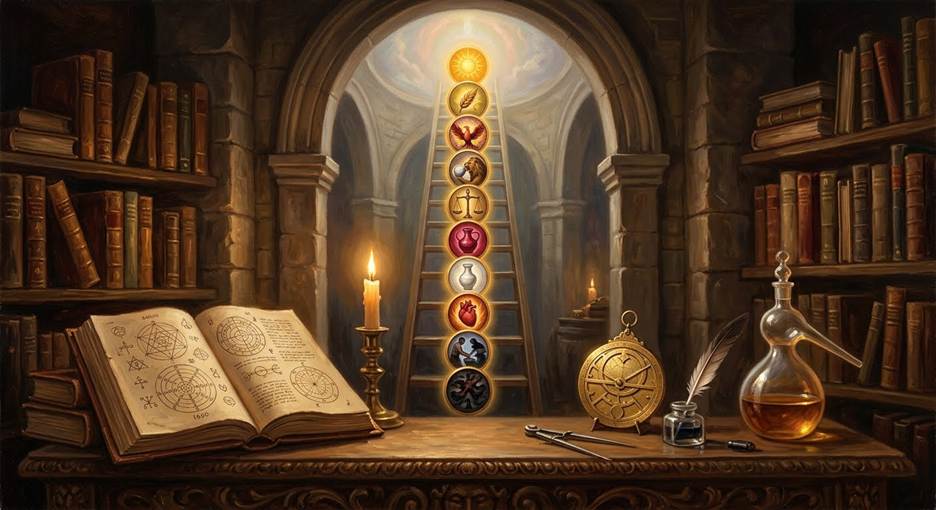
Mystical medieval library with ancient books, an illuminated symbolic staircase, open alchemy book, candles, compass, quill, and potion bottle

By Marilynn Hughes

When Arthur Dee compiled Fasciculus Chemicus in Moscow in 1629, he set out to accomplish something remarkably rare in the notoriously cryptic world of Renaissance alchemy. Rather than hiding the Great Work behind fragmented allegories or scattered riddles, the eldest son of Queen Elizabeth I’s famed court philosopher John Dee gathered the clearest passages from medieval and Renaissance masters—including Ramon Llull, Michael Maier, Gerhard Dorn, and Petrus Bonus—and arranged them into an orderly, ten-stage roadmap. Translated into English in 1650 by Elias Ashmole, these ten chapters chart the complete “Ingress, Progress, and Egress” of the Hermetic art. While Arthur Dee wrote as a practicing royal physician and laboratory chymist, each of his ten stages also mirrors the timeless inner journey of spiritual purification and mystical illumination.

To appreciate Fasciculus Chemicus, it helps to understand Arthur Dee’s unique role in esoteric history. Unlike his famous father, Arthur was neither an angelic visionary nor a speculative prophet; rather, he was a practicing royal physician—serving Tsar Mikhail I of Russia and later King Charles I of England—who acted as a master organizer and preserver of classical alchemy. Medieval and Renaissance alchemists deliberately scrambled their instructions behind riddles to keep their secrets hidden from the uninitiated, making the tradition notoriously difficult to follow. Arthur Dee’s enduring contribution was reading through dozens of scattered authorities and arranging their authentic words into a logical, chronological sequence from start to finish, creating a clear bridge between Elizabethan Hermeticism and the 17th-century Rosicrucian and Royal Society revivals.

The journey begins with the First Stage: Natural Matter (What it is, and from whence). Before any furnace can be lit, the alchemist must identify the Prima Materia—the hidden, unrefined root substance from which all things emerge. In the laboratory, this requires discerning the true philosophical mercury and sulfur concealed within common minerals. On the contemplative path, this opening step demands honest self-recognition, acknowledging the raw, unshaped material of the human soul before grace and discipline begin their work.

Once the foundational substance is identified, the practitioner enters the Second Stage: The Preparation (Or the First Work, or Work of the Winter). Dee describes this phase as a season of winter—a quiet, hidden period of cleansing, calcination, and dissolution in which coarse impurities are stripped away. Just as winter strips trees bare so new life can stir beneath the frost, spiritual preparation requires releasing earthly attachments, pride, and habitual illusions so the inner life becomes receptive to higher light.

Precision governs the Third Stage: The Weight in Preparation. In classical alchemy, even the finest ingredients fail if combined in reckless proportions; harmony depends upon exact measure and balance. Inwardly, this stage reflects spiritual discernment and temperance—the careful calibration of prayer, silence, contemplation, and daily action so that zeal never tips into imbalance or spiritual exhaustion.

With matter purified and weighed, the alchemist kindles the Fourth Stage: The Philosopher’s Fire. Dee emphasizes that this is no ordinary, destructive kitchen flame that burns substance to ash, but a gentle, sustained, secret heat regulated with tireless patience. Within the soul, the Philosopher’s Fire corresponds to the steady, inward warmth of devotion and contemplative attention—a sacred ardor that refines the heart without scorching it.

Out of that patient warmth emerges the Fifth Stage: The Rise or Birth of the Stone. Here, the long winter of dissolution gives way to the first visible flowering of the Philosopher’s Stone, marked by the classic alchemical color transitions from blackening (nigredo) to whitening (albedo). Spiritually, this marks the awakening of the regenerated self, when inner darkness yields to clarity, peace, and the dawning awareness of divine presence.

Yet the initial birth of the Stone is only the halfway mark, leading directly into the Sixth Stage: The Weights of the Second Work. Having achieved a preliminary state of purity, the alchemist must re-measure and re-balance the elements for a higher, more subtle phase of union. On the mystical path, early spiritual illumination must similarly be tested, stabilized, and integrated into deeper maturity so that fleeting visionary moments become enduring wisdom.

To nourish this developing Stone, the practitioner moves to the Seventh Stage: Imbibition. In laboratory terms, imbibition is the gradual, repeated feeding of the dry philosophical earth with purified liquid—drop by drop, never flooding the vessel. In contemplative life, it mirrors the patient absorption of sacred truth and divine grace, allowing spiritual insight to saturate the whole being slowly rather than overwhelming the mind all at once.

This gradual nourishment culminates in the Eighth Stage: Fermentation. Just as a small measure of leaven transforms an entire lump of dough, fermentation infuses the purified substance with living spirit, fixing its volatile nature into golden, incorruptible permanence (rubedo). Spiritually, fermentation represents the full union of the human soul with the Divine Spirit, wherein personal will is wholly animated and transformed from within.

Once perfected, the Stone is no longer kept locked inside the glass vessel, advancing to the Ninth Stage: Projection. In operational alchemy, projection is the decisive moment when a tiny grain of the Philosopher’s Stone is cast upon base lead or mercury, instantly transmuting it into pure gold. In the life of a mystic, projection is the outward overflow of inner realization—the quiet radiance of compassion, wisdom, and healing grace that uplifts others simply through authentic presence.

Finally, the Great Work reaches its boundless culmination in the Tenth Stage: Multiplication. Arthur Dee concludes his anthology with the mystery by which the Stone’s potency is continually renewed and increased in both quantity and strength without ever losing its essence. On the spiritual horizon, multiplication signifies the inexhaustible nature of divine illumination—the truth that the more love, wisdom, and spiritual light are shared with the world, the more abundantly they expand within the soul.

Arthur Dee’s ten operational chapters map directly onto the four classic alchemical color stages—Nigredo (Blackening), Albedo (Whitening), Citrinitas (Yellowing), and Rubedo (Reddening). While classical mystics used the four colors to describe the soul’s interior transformation, Arthur Dee broke those four broad movements down into ten precise steps in the furnace.

How the Ten Stages Align With the Four Classic Phases

  • 1. Nigredo (The Blackening — Death of the Ego & Dissolution)
    • Arthur Dee’s Stages: Stage 1 (Natural Matter), Stage 2 (The Preparation / Work of the Winter), and Stage 3 (The Weight in Preparation).
    • The Alignment: Nigredo is the dark, wintry beginning of the Great Work where raw, unrefined matter is broken down, stripped of impurities, and balanced. Spiritually, this corresponds to honest self-examination, humility, and letting go of worldly attachments so the soul becomes quiet and receptive.
  • 2. Albedo (The Whitening — Purification & Dawn of Clarity)
    • Arthur Dee’s Stages: Stage 4 (The Philosopher’s Fire) and Stage 5 (The Rise or Birth of the Stone).
    • The Alignment: Through steady, gentle heat, the blackened matter is washed clean and turns luminous white, marking the first visible birth of the Stone. Spiritually, Albedo is the purification of the heart and mind, where inner darkness yields to peace, moral clarity, and the awakening of spiritual sight.
  • 3. Citrinitas (The Yellowing — Spiritual Awakening & Solar Wisdom)
    • Arthur Dee’s Stages: Stage 6 (The Weights of the Second Work) and Stage 7 (Imbibition).
    • The Alignment: Often called the “dawning of the solar light,” Citrinitas occurs when the purified white stone is re-balanced and slowly nourished drop by drop with celestial moisture until it takes on a golden-yellow glow. Spiritually, this is the stage where early illumination matures into steady wisdom, as the soul patiently absorbs divine grace rather than relying on fleeting emotional highs.
  • 4. Rubedo (The Reddening — Divine Union & Overflowing Grace)
    • Arthur Dee’s Stages: Stage 8 (Fermentation), Stage 9 (Projection), and Stage 10 (Multiplication).
    • The Alignment: Rubedo is the triumphant climax of the Great Work, where the Stone is infused with living spirit, turns a radiant royal red, and gains the power to transmute base metals and multiply endlessly. Spiritually, this represents complete union with the Divine—where the transformed soul naturally radiates love, wisdom, and healing outward into the world without ever running dry.

Viewed as a unified ladder from Natural Matter to Multiplication—and placed alongside the four classical colors of Nigredo, Albedo, Citrinitas, and Rubedo—Arthur Dee’s ten stages demonstrate why Fasciculus Chemicus captivated 17th-century Hermeticists like Elias Ashmole as far more than a laboratory manual. Whether read beside an alchemical furnace or explored through the four interior seasons of the soul’s awakening in the stillness of contemplative prayer, Dee’s roadmap reminds seekers that true transformation is never accidental—it is an ordered, patient ascent from raw earthly beginnings to luminous, self-multiplying perfection.

From Angelic Mysticism to the Alchemical Furnace: John Dee, Arthur Dee, and Elias Ashmole’s Fasciculus Chemicus

Historical alchemists and scholars studying maps and manuscripts in a candlelit medieval study.

By Marilynn Hughes

John Dee (1527–1608) was one of the most brilliant and enigmatic figures of the English Renaissance—a mathematician, astronomer, navigator, and royal advisor who stood at the crossroads of emerging modern science and ancient Hermetic mysticism. Educated at Cambridge and celebrated across the courts of Europe, Dee served as trusted astrologer and scientific counselor to Queen Elizabeth I, even selecting the auspicious date for her coronation and coining the term “British Empire”. At his home in Mortlake, he assembled one of the largest private libraries in England, housing thousands of rare manuscripts on mathematics, optics, alchemy, Kabbalah, and classical antiquity. To Dee, there was no division between rigorous scientific inquiry and spiritual revelation; he believed that sacred geometry and the hidden laws of the cosmos were the very language through which God structured creation, a philosophy he captured in his famous 1564 work, Monas Hieroglyphica.

Yet Dee’s deepest ambition went beyond earthly scholarship to direct communion with the angelic realms. Convinced that humanity could recover the lost spiritual wisdom of Adam before the Fall, Dee spent years conducting intensive prayer and crystal-gazing sessions—most famously alongside the seer Edward Kelley across England and Central Europe—to transcribe an intricate system of angelic language and cosmology known today as Enochian magic. While his contemporaries often misunderstood his work as dark sorcery, leading to the looting of his beloved library and his eventual poverty in old age, Dee always viewed himself as a devout Christian philosopher seeking divine illumination. His synthesis of Hermetic philosophy, sacred mathematics, and visionary spirit communication left an indelible mark on the Western esoteric tradition, directly inspiring the 17th-century Rosicrucian movement and generations of mystics who followed.

John Dee’s eldest son, Arthur Dee (1579–1651), inherited his father’s esoteric and alchemical traditions, translating them into a career in medicine and laboratory alchemy that bridged Elizabethan Hermeticism with 17th-century revivals. Raised inside the famed Mortlake library, Arthur grew up surrounded by the greatest Hermetic texts in Renaissance Europe. As a young boy accompanying his father and Edward Kelley in Prague and Trebona, he played with gold and silver discs they claimed to have transmuted in the furnace, and at age eight he even briefly served as his father’s crystal-gazing scryer before Kelley resumed the role. Yet as an adult, Arthur deliberately avoided angelic conjurations and political mysticism—likely having witnessed the ruin and poverty they brought upon his father back in England. Instead, he pursued a distinguished path as an orthodox physician and practicing chymist, serving for fourteen years in Moscow as personal physician to Tsar Mikhail I of Russia before returning to England as physician-in-ordinary to King Charles I.

It was during his years in Moscow in 1629 that Arthur Dee compiled his enduring contribution to Western esoteric literature, Fasciculus Chemicus, or Chymical Collections: Expressing the Ingress, Progress, and Egress, of the Secret Hermetick Science, Out of the Choisest and Most Famous Authors. Rather than recording visionary revelations or speculative philosophy, Arthur designed the book as a clear, systematic anthology of operational alchemy. Drawing carefully selected passages from medieval and Renaissance masters—including Ramon Llull, Michael Maier, Gerhard Dorn, and Petrus Bonus—he organized their veiled writings into a structured ten-stage roadmap of the Great Work, tracing the process from the preparation of Natural Matter through Fermentation, Projection, and Multiplication. In doing so, Arthur preserved the practical laboratory wisdom of the classical alchemists in a concise manual that sparked a major revival of English Hermetic publishing when it was translated from Latin into English in 1650.

That landmark 1650 English translation was undertaken by Elias Ashmole—an early Freemason, astrologer, antiquarian, and founding Fellow of the Royal Society—who published the volume under the anagrammatic pseudonym “James Hasolle”. While Arthur Dee’s main text consists of technical laboratory instructions, Ashmole’s introduction, known as The Prolegomena, is widely considered the most philosophically and mystically rich portion of the entire book. Reading like a passionate spiritual manifesto, Ashmole’s preface defends Hermetic wisdom, Rosicrucian secrecy, and the inner moral purification required of the true seeker.

Throughout The Prolegomena, Ashmole weaves laboratory alchemy directly back into the high spiritual philosophy of The Corpus Hermeticum and the ancient Mystery Religions. He explains that the ancient sages veiled their deepest truths behind symbols and riddles so that divine wisdom would remain hidden from the greedy and spiritually unprepared. Echoing timeless Hermetic principles, Ashmole insists that no one can master the “Hermetick Science” through intellect or furnace equipment alone; the seeker must first cleanse their soul of pride, avarice, and earthly passions, recognizing that true illumination is a gift granted by Divine Providence to the humble heart. Written at the height of English Rosicrucian enthusiasm, his preface openly praises the Fraternity of the Rosy Cross and frames alchemy within a unified cosmos governed by planetary sympathies and the World Soul (Anima Mundi). Alongside his introduction, Ashmole commissioned a celebrated hieroglyphic frontispiece—depicting pillars, solar and lunar emblems, and the alchemical phoenix—visually uniting the traditions of Elizabethan Hermeticism, Rosicrucian mysticism, and speculative Freemasonry into a single unbroken lineage.

Taken together, the journey from John Dee’s angelic contemplations to Arthur Dee’s operational Fasciculus Chemicus and Elias Ashmole’s Prolegomena reveals the dual nature at the heart of the Western esoteric tradition. Whether approached through sacred geometry, visionary prayer, or the patient refinement of matter in the laboratory, the true Great Work has always mirrored the inner transmutation of the human soul. By preserving the practical stages of classical alchemy and framing them within a call to spiritual humility and divine illumination, this remarkable lineage reminds modern seekers that outward knowledge and inward purification are two halves of a single sacred path.

The Boundless Journey: The Spiritual Wonder of Out-of-Body Travel

Dreaming person surrounded by a glowing celestial figure, Earth, spiral galaxy, waterfalls, and a radiant fantasy castle.

By Marilynn Hughes

There are experiences in human life that have the power to transform our understanding of existence itself. Out-of-body travel is one of these extraordinary possibilities, opening a doorway to experiences that extend beyond the familiar boundaries of the physical world and inviting us to consider the greater dimensions of consciousness, spirit, and the eternal nature of the soul.

For many people, the physical body represents the entirety of their experience of being alive. We see through our eyes, hear through our ears, touch the world around us, and naturally come to identify our existence with the physical senses. Yet mystical experience can reveal a much greater reality, one in which consciousness is not necessarily confined to the physical limitations through which we ordinarily perceive the world. Out-of-body travel offers an opportunity to explore this greater reality through direct experience rather than speculation alone.

One of the most remarkable aspects of these experiences is the expansion of our understanding of what it means to be human. We begin to recognize that our identity may be far more extensive than the physical personality, its circumstances, and its temporary concerns. The soul’s journey can open perspectives that are difficult to imagine from within ordinary waking consciousness, revealing dimensions of experience that inspire wonder, reverence, and a deeper appreciation for the mystery of creation.

Out-of-body experiences can also become profound opportunities for spiritual discovery. Encounters with unfamiliar environments, extraordinary landscapes, spiritual realities, and forms of consciousness beyond ordinary human experience can awaken questions about the nature of existence and our place within it. These experiences may encourage us to look beyond the material concerns that so often dominate daily life and consider the eternal dimensions of our being.

Yet perhaps the greatest gift of out-of-body travel is not simply the opportunity to explore what lies beyond the physical world. It is the transformation that can take place within the soul as a result of these experiences. When we begin to contemplate the vastness of spiritual existence, the ordinary boundaries of our understanding can fall away. We may become more conscious of the sacredness of life, more compassionate toward others, and more aware that our earthly existence is part of a much greater spiritual journey.

This exploration also invites humility. The spiritual dimensions of creation are vast, and no human being can presume to possess complete knowledge of them. Every experience, every discovery, and every new understanding can remind us of how much remains beyond our present comprehension. The journey is not about conquering spiritual worlds or acquiring power over unseen realities. It is about becoming more receptive to the wonders of God’s creation and allowing genuine mystical experience to deepen our reverence for the Divine.

In this sense, out-of-body travel can be understood as part of a larger spiritual pilgrimage. It encourages us to look beyond appearances, to question the limitations of ordinary perception, and to recognize that the human soul may participate in a reality far greater than the physical world alone. The experiences themselves can be extraordinary, but their deepest value may lie in how they change the way we live, love, understand, and seek God.

The boundless journey is ultimately an invitation to wonder. It reminds us that existence is filled with mysteries still waiting to be encountered, that consciousness holds possibilities we have only begun to understand, and that the spiritual life is not limited to what can be measured by the physical senses. For those who have experienced these dimensions firsthand, out-of-body travel can become a lifelong exploration of the mysteries of creation and the eternal journey of the soul.

There is so much more to existence than we ordinarily perceive. And perhaps one of the greatest gifts of mystical exploration is the opportunity to discover that the journey of the soul is far more expansive, beautiful, and wondrous than we ever imagined.

Continue Your Journey with The Out-of-Body Travel Foundation

Since 2003, The Out-of-Body Travel Foundation has worked toward its mission to reduce spiritual hunger worldwide by making knowledge, research, and educational resources available to all who seek a deeper understanding of out-of-body travel and comparative religious mysticism. We invite you to explore the many resources available through our website, including:

  • Books: More than 148 books on out-of-body travel, mystical experience, and comparative religious mysticism.
  • Documentary Films: Films exploring the mysteries of consciousness, spirituality, and the soul’s journey.
  • Feature Films: Cinematic projects bringing spiritual and mystical themes to a wider audience.
  • Musical Sound Journeys: Original musical explorations designed to accompany reflection, contemplation, and inner journeys.
  • Meditations: Resources for contemplative practice and spiritual exploration.
  • Seminars: Educational presentations and opportunities to explore the subjects of out-of-body travel and mysticism in greater depth.
  • Vignettes: Short presentations and glimpses into the extraordinary world of mystical experience.
  • Archived Appearances: Radio, television, and other media appearances, with an archive extending back to 1992.
  • Articles and Research: A growing collection of writings exploring out-of-body travel, spiritual traditions, mystical theology, and the many dimensions of human consciousness.

These resources are offered as an invitation to explore, learn, question, and discover. Whether you are just beginning to investigate out-of-body travel or have spent many years exploring the mysteries of spiritual existence, we welcome you to join us on this boundless journey.

Explore The Out-of-Body Travel Foundation at outofbodytravel.org.

The Violation of Eternal Law and the Great Inversions

Mystical woman holding a glowing crystal orb before a celestial staircase leading to a radiant castle, with magical symbols, candles, flowers, and an open book.

By Marilynn Hughes

One of the most consequential developments in certain currents of modern occultism was the belief that the spiritual dimensions could be entered, explored, influenced, and manipulated through the application of specialized techniques. Rituals, formulas, symbols, psychic disciplines, invocations, and systems of mental concentration were presented as means through which the practitioner could acquire access to spiritual powers and realities. In later forms of esoteric and New Age thought, related ideas have continued in different language, often through the belief that human consciousness can direct subtle energies, influence unseen forces, or bring about spiritual results through the exercise of personal intention.

The central issue is not whether spiritual dimensions exist, whether human consciousness can experience realities beyond the physical senses, or whether extraordinary spiritual experiences are possible. The issue is the assumption that human beings possess the authority to enter and manipulate those dimensions through their own will.

From the standpoint of Eternal Law, this is a profound inversion.

The spiritual universe is not an arena in which human beings are entitled to exercise power simply because they have discovered a technique, learned a formula, or developed a particular psychic capacity. The existence of spiritual realities does not grant humanity sovereignty over them. Nor does the ability to produce an unusual experience establish that the experience has been granted by God, that the realm encountered is holy, or that the practitioner is moving toward Divine Union.

The distinction between genuine mystical experience and the pursuit of personal spiritual power is therefore essential. In the path of Divine Grace, the soul does not force its way into the spiritual realms. It does not claim ownership of spiritual dimensions, nor does it presume that it can command the conditions under which Divine realities are revealed. The soul is purified, humbled, and made receptive. What is experienced is given according to the Will of God, not seized according to the will of the individual.

This distinction cannot be resolved simply by dividing magical practices into categories of white and black magic. A practitioner may claim benevolent intentions, speak of healing, spiritual development, service, or the advancement of humanity, and still be operating from the assumption that personal will has the authority to direct spiritual forces. Good intentions do not, by themselves, make an action lawful within the spiritual order. The deeper question is whether the action proceeds from obedience to God or from the desire to impose the human will upon creation.

In my own mystical understanding, this is a violation of Eternal Law. The soul is not authorized to manipulate the spiritual dimensions according to its own ambitions. Only God decides, through the Holy Spirit. The movement of consciousness into spiritual realities, the granting of mystical vision, and the experience of higher states of awareness must remain within the sovereignty of Divine Will. They are not possessions to be acquired through technique.

I have encountered the consequences of this distinction repeatedly in mystical experience. The Lord Demon has been shown to me as a demonic force whose work is to draw souls away from God. One of the ways this deception operates is by making the pursuit of spiritual power appear to be the pursuit of spiritual advancement. The practitioner may believe that the acquisition of secret knowledge, the ability to navigate unseen realms, or the mastery of psychic techniques represents a higher form of enlightenment. Yet the very desire to command what should be approached through humility can become the opening through which spiritual deception takes hold.

This is one of the great inversions: the soul believes it is ascending because it has acquired new powers, while the deeper movement may be away from the humility and obedience that make genuine ascent possible.

The contrast with the great mystical tradition is unmistakable. In the writings of the Christian mystics, purification is not a method for increasing the power of the individual ego. It is the gradual surrender of self-will. The soul learns that it cannot force God to reveal Himself, cannot manufacture Divine Grace, and cannot determine the course of its own ascent into the highest spiritual realities. Even profound experiences must be held with humility. The mystic does not claim authority over God because a vision has been granted. Rather, the experience deepens the recognition of God’s authority.

The teaching of obedience is therefore not a restriction imposed upon spiritual freedom. It is a protection against the confusion of personal desire with Divine Will. When the human intellect becomes convinced that it can master the spiritual universe, it repeats the essential error of the Fall: the attempt to possess knowledge and authority independently of God.

The Lord Demon is especially effective in this territory because the deception can be presented in sophisticated forms. It need not appear as crude wickedness or an obvious rejection of the Divine. It can be wrapped in elaborate philosophy, elaborate spiritual systems, claims of initiation, and the promise of extraordinary knowledge. It can persuade even highly educated people that ordinary faith is beneath them, that obedience belongs to the spiritually immature, and that the acquisition of hidden powers is evidence of advancement.

But knowledge of spiritual terminology is not the same as knowledge of God. The ability to describe unseen dimensions is not the same as holiness. Psychic capacity is not purification, and the experience of unusual phenomena is not proof of Divine approval. The decisive question remains whether the soul is becoming more obedient to God or more devoted to its own power.

The forbidden knowledge of good and evil, in this deeper sense, is the belief that human self-intelligence can stand above the supreme knowledge of God. It is the conviction that we can decide for ourselves what spiritual laws should govern us, what powers we may exercise, and what realities we may enter, without surrendering our will to the Creator.

The true mystical path moves in the opposite direction. It does not seek to conquer the spiritual universe. It seeks to become purified enough to receive what God chooses to give. It does not elevate the individual will into a sovereign power. It places that will in humble surrender to the Divine. And it does not mistake the acquisition of spiritual abilities for the attainment of holiness.

Eternal Law is not overcome by human ingenuity. The soul finds its freedom not by imposing its will upon creation, but by coming into harmony with the Will of God. Only through that surrender can spiritual experience become a movement toward Him rather than an avenue through which the soul is led away.