By Marilynn Hughes
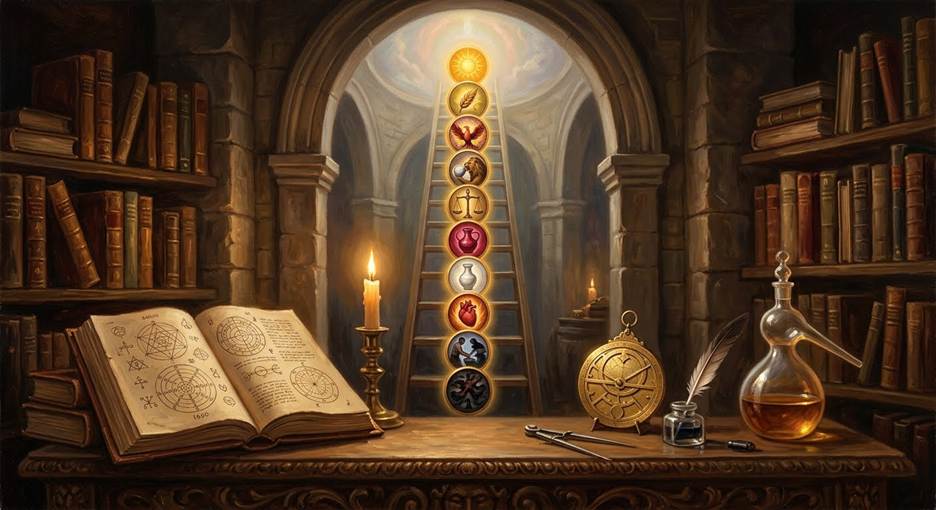
When Arthur Dee compiled Fasciculus Chemicus in Moscow in 1629, he set out to accomplish something remarkably rare in the notoriously cryptic world of Renaissance alchemy. Rather than hiding the Great Work behind fragmented allegories or scattered riddles, the eldest son of Queen Elizabeth I’s famed court philosopher John Dee gathered the clearest passages from medieval and Renaissance masters—including Ramon Llull, Michael Maier, Gerhard Dorn, and Petrus Bonus—and arranged them into an orderly, ten-stage roadmap. Translated into English in 1650 by Elias Ashmole, these ten chapters chart the complete “Ingress, Progress, and Egress” of the Hermetic art. While Arthur Dee wrote as a practicing royal physician and laboratory chymist, each of his ten stages also mirrors the timeless inner journey of spiritual purification and mystical illumination.
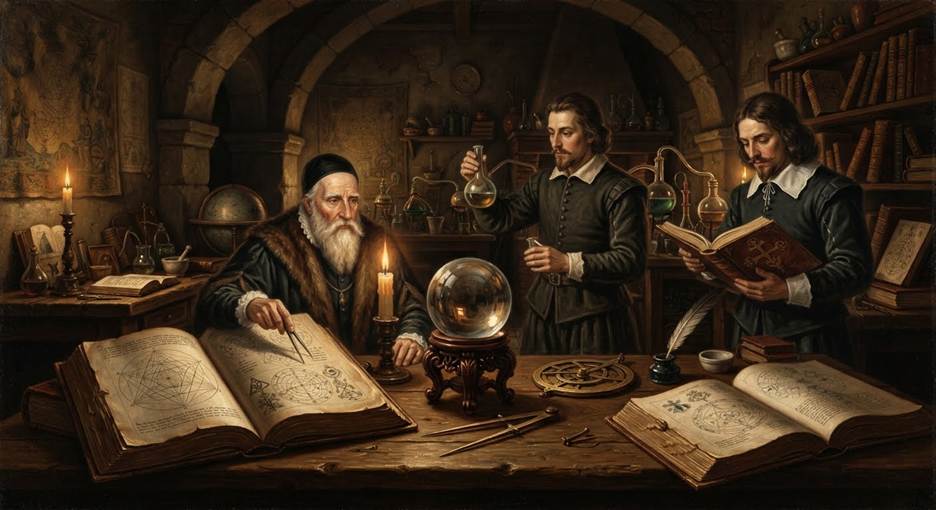
To appreciate Fasciculus Chemicus, it helps to understand Arthur Dee’s unique role in esoteric history. Unlike his famous father, Arthur was neither an angelic visionary nor a speculative prophet; rather, he was a practicing royal physician—serving Tsar Mikhail I of Russia and later King Charles I of England—who acted as a master organizer and preserver of classical alchemy. Medieval and Renaissance alchemists deliberately scrambled their instructions behind riddles to keep their secrets hidden from the uninitiated, making the tradition notoriously difficult to follow. Arthur Dee’s enduring contribution was reading through dozens of scattered authorities and arranging their authentic words into a logical, chronological sequence from start to finish, creating a clear bridge between Elizabethan Hermeticism and the 17th-century Rosicrucian and Royal Society revivals.
The journey begins with the First Stage: Natural Matter (What it is, and from whence). Before any furnace can be lit, the alchemist must identify the Prima Materia—the hidden, unrefined root substance from which all things emerge. In the laboratory, this requires discerning the true philosophical mercury and sulfur concealed within common minerals. On the contemplative path, this opening step demands honest self-recognition, acknowledging the raw, unshaped material of the human soul before grace and discipline begin their work.
Once the foundational substance is identified, the practitioner enters the Second Stage: The Preparation (Or the First Work, or Work of the Winter). Dee describes this phase as a season of winter—a quiet, hidden period of cleansing, calcination, and dissolution in which coarse impurities are stripped away. Just as winter strips trees bare so new life can stir beneath the frost, spiritual preparation requires releasing earthly attachments, pride, and habitual illusions so the inner life becomes receptive to higher light.
Precision governs the Third Stage: The Weight in Preparation. In classical alchemy, even the finest ingredients fail if combined in reckless proportions; harmony depends upon exact measure and balance. Inwardly, this stage reflects spiritual discernment and temperance—the careful calibration of prayer, silence, contemplation, and daily action so that zeal never tips into imbalance or spiritual exhaustion.
With matter purified and weighed, the alchemist kindles the Fourth Stage: The Philosopher’s Fire. Dee emphasizes that this is no ordinary, destructive kitchen flame that burns substance to ash, but a gentle, sustained, secret heat regulated with tireless patience. Within the soul, the Philosopher’s Fire corresponds to the steady, inward warmth of devotion and contemplative attention—a sacred ardor that refines the heart without scorching it.
Out of that patient warmth emerges the Fifth Stage: The Rise or Birth of the Stone. Here, the long winter of dissolution gives way to the first visible flowering of the Philosopher’s Stone, marked by the classic alchemical color transitions from blackening (nigredo) to whitening (albedo). Spiritually, this marks the awakening of the regenerated self, when inner darkness yields to clarity, peace, and the dawning awareness of divine presence.
Yet the initial birth of the Stone is only the halfway mark, leading directly into the Sixth Stage: The Weights of the Second Work. Having achieved a preliminary state of purity, the alchemist must re-measure and re-balance the elements for a higher, more subtle phase of union. On the mystical path, early spiritual illumination must similarly be tested, stabilized, and integrated into deeper maturity so that fleeting visionary moments become enduring wisdom.
To nourish this developing Stone, the practitioner moves to the Seventh Stage: Imbibition. In laboratory terms, imbibition is the gradual, repeated feeding of the dry philosophical earth with purified liquid—drop by drop, never flooding the vessel. In contemplative life, it mirrors the patient absorption of sacred truth and divine grace, allowing spiritual insight to saturate the whole being slowly rather than overwhelming the mind all at once.
This gradual nourishment culminates in the Eighth Stage: Fermentation. Just as a small measure of leaven transforms an entire lump of dough, fermentation infuses the purified substance with living spirit, fixing its volatile nature into golden, incorruptible permanence (rubedo). Spiritually, fermentation represents the full union of the human soul with the Divine Spirit, wherein personal will is wholly animated and transformed from within.
Once perfected, the Stone is no longer kept locked inside the glass vessel, advancing to the Ninth Stage: Projection. In operational alchemy, projection is the decisive moment when a tiny grain of the Philosopher’s Stone is cast upon base lead or mercury, instantly transmuting it into pure gold. In the life of a mystic, projection is the outward overflow of inner realization—the quiet radiance of compassion, wisdom, and healing grace that uplifts others simply through authentic presence.
Finally, the Great Work reaches its boundless culmination in the Tenth Stage: Multiplication. Arthur Dee concludes his anthology with the mystery by which the Stone’s potency is continually renewed and increased in both quantity and strength without ever losing its essence. On the spiritual horizon, multiplication signifies the inexhaustible nature of divine illumination—the truth that the more love, wisdom, and spiritual light are shared with the world, the more abundantly they expand within the soul.
Arthur Dee’s ten operational chapters map directly onto the four classic alchemical color stages—Nigredo (Blackening), Albedo (Whitening), Citrinitas (Yellowing), and Rubedo (Reddening). While classical mystics used the four colors to describe the soul’s interior transformation, Arthur Dee broke those four broad movements down into ten precise steps in the furnace.
How the Ten Stages Align With the Four Classic Phases
- 1. Nigredo (The Blackening — Death of the Ego & Dissolution)
- Arthur Dee’s Stages: Stage 1 (Natural Matter), Stage 2 (The Preparation / Work of the Winter), and Stage 3 (The Weight in Preparation).
- The Alignment: Nigredo is the dark, wintry beginning of the Great Work where raw, unrefined matter is broken down, stripped of impurities, and balanced. Spiritually, this corresponds to honest self-examination, humility, and letting go of worldly attachments so the soul becomes quiet and receptive.
- 2. Albedo (The Whitening — Purification & Dawn of Clarity)
- Arthur Dee’s Stages: Stage 4 (The Philosopher’s Fire) and Stage 5 (The Rise or Birth of the Stone).
- The Alignment: Through steady, gentle heat, the blackened matter is washed clean and turns luminous white, marking the first visible birth of the Stone. Spiritually, Albedo is the purification of the heart and mind, where inner darkness yields to peace, moral clarity, and the awakening of spiritual sight.
- 3. Citrinitas (The Yellowing — Spiritual Awakening & Solar Wisdom)
- Arthur Dee’s Stages: Stage 6 (The Weights of the Second Work) and Stage 7 (Imbibition).
- The Alignment: Often called the “dawning of the solar light,” Citrinitas occurs when the purified white stone is re-balanced and slowly nourished drop by drop with celestial moisture until it takes on a golden-yellow glow. Spiritually, this is the stage where early illumination matures into steady wisdom, as the soul patiently absorbs divine grace rather than relying on fleeting emotional highs.
- 4. Rubedo (The Reddening — Divine Union & Overflowing Grace)
- Arthur Dee’s Stages: Stage 8 (Fermentation), Stage 9 (Projection), and Stage 10 (Multiplication).
- The Alignment: Rubedo is the triumphant climax of the Great Work, where the Stone is infused with living spirit, turns a radiant royal red, and gains the power to transmute base metals and multiply endlessly. Spiritually, this represents complete union with the Divine—where the transformed soul naturally radiates love, wisdom, and healing outward into the world without ever running dry.
Viewed as a unified ladder from Natural Matter to Multiplication—and placed alongside the four classical colors of Nigredo, Albedo, Citrinitas, and Rubedo—Arthur Dee’s ten stages demonstrate why Fasciculus Chemicus captivated 17th-century Hermeticists like Elias Ashmole as far more than a laboratory manual. Whether read beside an alchemical furnace or explored through the four interior seasons of the soul’s awakening in the stillness of contemplative prayer, Dee’s roadmap reminds seekers that true transformation is never accidental—it is an ordered, patient ascent from raw earthly beginnings to luminous, self-multiplying perfection.