
By Marilynn Hughes
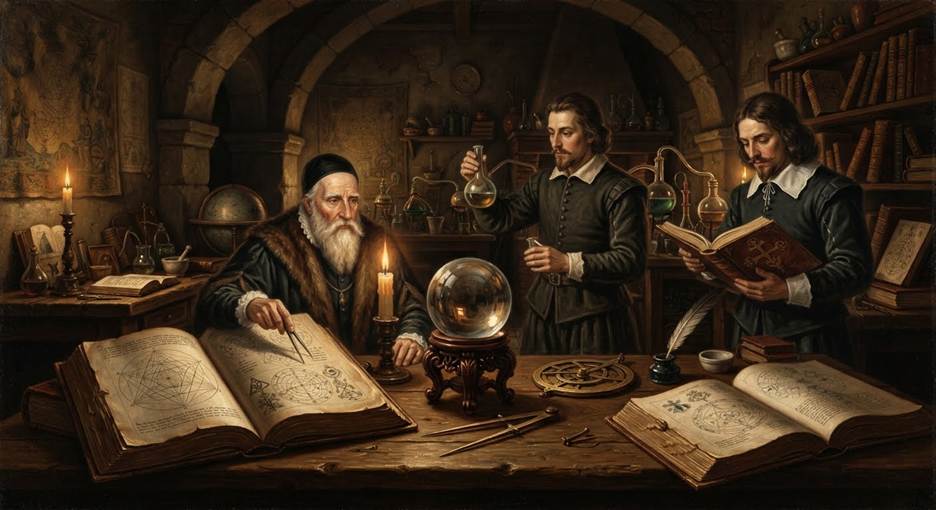
John Dee (1527–1608) was one of the most brilliant and enigmatic figures of the English Renaissance—a mathematician, astronomer, navigator, and royal advisor who stood at the crossroads of emerging modern science and ancient Hermetic mysticism. Educated at Cambridge and celebrated across the courts of Europe, Dee served as trusted astrologer and scientific counselor to Queen Elizabeth I, even selecting the auspicious date for her coronation and coining the term “British Empire”. At his home in Mortlake, he assembled one of the largest private libraries in England, housing thousands of rare manuscripts on mathematics, optics, alchemy, Kabbalah, and classical antiquity. To Dee, there was no division between rigorous scientific inquiry and spiritual revelation; he believed that sacred geometry and the hidden laws of the cosmos were the very language through which God structured creation, a philosophy he captured in his famous 1564 work, Monas Hieroglyphica.
Yet Dee’s deepest ambition went beyond earthly scholarship to direct communion with the angelic realms. Convinced that humanity could recover the lost spiritual wisdom of Adam before the Fall, Dee spent years conducting intensive prayer and crystal-gazing sessions—most famously alongside the seer Edward Kelley across England and Central Europe—to transcribe an intricate system of angelic language and cosmology known today as Enochian magic. While his contemporaries often misunderstood his work as dark sorcery, leading to the looting of his beloved library and his eventual poverty in old age, Dee always viewed himself as a devout Christian philosopher seeking divine illumination. His synthesis of Hermetic philosophy, sacred mathematics, and visionary spirit communication left an indelible mark on the Western esoteric tradition, directly inspiring the 17th-century Rosicrucian movement and generations of mystics who followed.
John Dee’s eldest son, Arthur Dee (1579–1651), inherited his father’s esoteric and alchemical traditions, translating them into a career in medicine and laboratory alchemy that bridged Elizabethan Hermeticism with 17th-century revivals. Raised inside the famed Mortlake library, Arthur grew up surrounded by the greatest Hermetic texts in Renaissance Europe. As a young boy accompanying his father and Edward Kelley in Prague and Trebona, he played with gold and silver discs they claimed to have transmuted in the furnace, and at age eight he even briefly served as his father’s crystal-gazing scryer before Kelley resumed the role. Yet as an adult, Arthur deliberately avoided angelic conjurations and political mysticism—likely having witnessed the ruin and poverty they brought upon his father back in England. Instead, he pursued a distinguished path as an orthodox physician and practicing chymist, serving for fourteen years in Moscow as personal physician to Tsar Mikhail I of Russia before returning to England as physician-in-ordinary to King Charles I.
It was during his years in Moscow in 1629 that Arthur Dee compiled his enduring contribution to Western esoteric literature, Fasciculus Chemicus, or Chymical Collections: Expressing the Ingress, Progress, and Egress, of the Secret Hermetick Science, Out of the Choisest and Most Famous Authors. Rather than recording visionary revelations or speculative philosophy, Arthur designed the book as a clear, systematic anthology of operational alchemy. Drawing carefully selected passages from medieval and Renaissance masters—including Ramon Llull, Michael Maier, Gerhard Dorn, and Petrus Bonus—he organized their veiled writings into a structured ten-stage roadmap of the Great Work, tracing the process from the preparation of Natural Matter through Fermentation, Projection, and Multiplication. In doing so, Arthur preserved the practical laboratory wisdom of the classical alchemists in a concise manual that sparked a major revival of English Hermetic publishing when it was translated from Latin into English in 1650.
That landmark 1650 English translation was undertaken by Elias Ashmole—an early Freemason, astrologer, antiquarian, and founding Fellow of the Royal Society—who published the volume under the anagrammatic pseudonym “James Hasolle”. While Arthur Dee’s main text consists of technical laboratory instructions, Ashmole’s introduction, known as The Prolegomena, is widely considered the most philosophically and mystically rich portion of the entire book. Reading like a passionate spiritual manifesto, Ashmole’s preface defends Hermetic wisdom, Rosicrucian secrecy, and the inner moral purification required of the true seeker.
Throughout The Prolegomena, Ashmole weaves laboratory alchemy directly back into the high spiritual philosophy of The Corpus Hermeticum and the ancient Mystery Religions. He explains that the ancient sages veiled their deepest truths behind symbols and riddles so that divine wisdom would remain hidden from the greedy and spiritually unprepared. Echoing timeless Hermetic principles, Ashmole insists that no one can master the “Hermetick Science” through intellect or furnace equipment alone; the seeker must first cleanse their soul of pride, avarice, and earthly passions, recognizing that true illumination is a gift granted by Divine Providence to the humble heart. Written at the height of English Rosicrucian enthusiasm, his preface openly praises the Fraternity of the Rosy Cross and frames alchemy within a unified cosmos governed by planetary sympathies and the World Soul (Anima Mundi). Alongside his introduction, Ashmole commissioned a celebrated hieroglyphic frontispiece—depicting pillars, solar and lunar emblems, and the alchemical phoenix—visually uniting the traditions of Elizabethan Hermeticism, Rosicrucian mysticism, and speculative Freemasonry into a single unbroken lineage.
Taken together, the journey from John Dee’s angelic contemplations to Arthur Dee’s operational Fasciculus Chemicus and Elias Ashmole’s Prolegomena reveals the dual nature at the heart of the Western esoteric tradition. Whether approached through sacred geometry, visionary prayer, or the patient refinement of matter in the laboratory, the true Great Work has always mirrored the inner transmutation of the human soul. By preserving the practical stages of classical alchemy and framing them within a call to spiritual humility and divine illumination, this remarkable lineage reminds modern seekers that outward knowledge and inward purification are two halves of a single sacred path.

