
By Marilynn Hughes
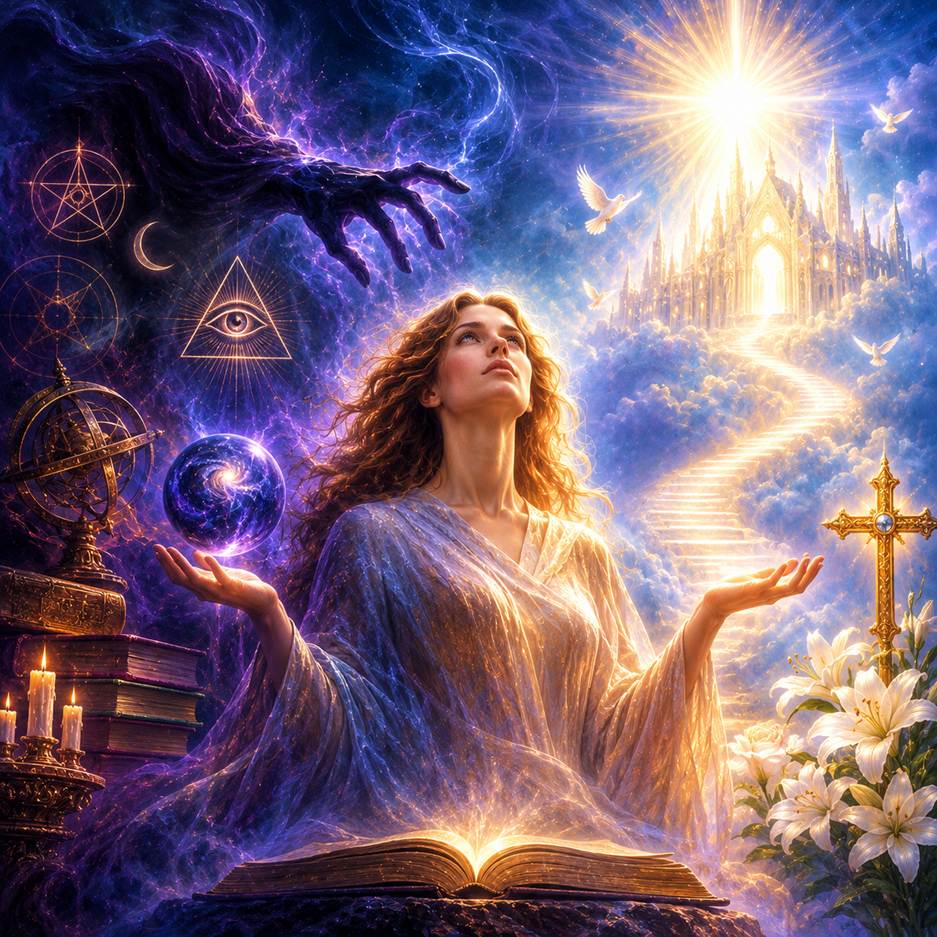
One of the most consequential developments in certain currents of modern occultism was the belief that the spiritual dimensions could be entered, explored, influenced, and manipulated through the application of specialized techniques. Rituals, formulas, symbols, psychic disciplines, invocations, and systems of mental concentration were presented as means through which the practitioner could acquire access to spiritual powers and realities. In later forms of esoteric and New Age thought, related ideas have continued in different language, often through the belief that human consciousness can direct subtle energies, influence unseen forces, or bring about spiritual results through the exercise of personal intention.
The central issue is not whether spiritual dimensions exist, whether human consciousness can experience realities beyond the physical senses, or whether extraordinary spiritual experiences are possible. The issue is the assumption that human beings possess the authority to enter and manipulate those dimensions through their own will.
From the standpoint of Eternal Law, this is a profound inversion.
The spiritual universe is not an arena in which human beings are entitled to exercise power simply because they have discovered a technique, learned a formula, or developed a particular psychic capacity. The existence of spiritual realities does not grant humanity sovereignty over them. Nor does the ability to produce an unusual experience establish that the experience has been granted by God, that the realm encountered is holy, or that the practitioner is moving toward Divine Union.
The distinction between genuine mystical experience and the pursuit of personal spiritual power is therefore essential. In the path of Divine Grace, the soul does not force its way into the spiritual realms. It does not claim ownership of spiritual dimensions, nor does it presume that it can command the conditions under which Divine realities are revealed. The soul is purified, humbled, and made receptive. What is experienced is given according to the Will of God, not seized according to the will of the individual.
This distinction cannot be resolved simply by dividing magical practices into categories of white and black magic. A practitioner may claim benevolent intentions, speak of healing, spiritual development, service, or the advancement of humanity, and still be operating from the assumption that personal will has the authority to direct spiritual forces. Good intentions do not, by themselves, make an action lawful within the spiritual order. The deeper question is whether the action proceeds from obedience to God or from the desire to impose the human will upon creation.
In my own mystical understanding, this is a violation of Eternal Law. The soul is not authorized to manipulate the spiritual dimensions according to its own ambitions. Only God decides, through the Holy Spirit. The movement of consciousness into spiritual realities, the granting of mystical vision, and the experience of higher states of awareness must remain within the sovereignty of Divine Will. They are not possessions to be acquired through technique.
I have encountered the consequences of this distinction repeatedly in mystical experience. The Lord Demon has been shown to me as a demonic force whose work is to draw souls away from God. One of the ways this deception operates is by making the pursuit of spiritual power appear to be the pursuit of spiritual advancement. The practitioner may believe that the acquisition of secret knowledge, the ability to navigate unseen realms, or the mastery of psychic techniques represents a higher form of enlightenment. Yet the very desire to command what should be approached through humility can become the opening through which spiritual deception takes hold.
This is one of the great inversions: the soul believes it is ascending because it has acquired new powers, while the deeper movement may be away from the humility and obedience that make genuine ascent possible.
The contrast with the great mystical tradition is unmistakable. In the writings of the Christian mystics, purification is not a method for increasing the power of the individual ego. It is the gradual surrender of self-will. The soul learns that it cannot force God to reveal Himself, cannot manufacture Divine Grace, and cannot determine the course of its own ascent into the highest spiritual realities. Even profound experiences must be held with humility. The mystic does not claim authority over God because a vision has been granted. Rather, the experience deepens the recognition of God’s authority.
The teaching of obedience is therefore not a restriction imposed upon spiritual freedom. It is a protection against the confusion of personal desire with Divine Will. When the human intellect becomes convinced that it can master the spiritual universe, it repeats the essential error of the Fall: the attempt to possess knowledge and authority independently of God.
The Lord Demon is especially effective in this territory because the deception can be presented in sophisticated forms. It need not appear as crude wickedness or an obvious rejection of the Divine. It can be wrapped in elaborate philosophy, elaborate spiritual systems, claims of initiation, and the promise of extraordinary knowledge. It can persuade even highly educated people that ordinary faith is beneath them, that obedience belongs to the spiritually immature, and that the acquisition of hidden powers is evidence of advancement.
But knowledge of spiritual terminology is not the same as knowledge of God. The ability to describe unseen dimensions is not the same as holiness. Psychic capacity is not purification, and the experience of unusual phenomena is not proof of Divine approval. The decisive question remains whether the soul is becoming more obedient to God or more devoted to its own power.
The forbidden knowledge of good and evil, in this deeper sense, is the belief that human self-intelligence can stand above the supreme knowledge of God. It is the conviction that we can decide for ourselves what spiritual laws should govern us, what powers we may exercise, and what realities we may enter, without surrendering our will to the Creator.
The true mystical path moves in the opposite direction. It does not seek to conquer the spiritual universe. It seeks to become purified enough to receive what God chooses to give. It does not elevate the individual will into a sovereign power. It places that will in humble surrender to the Divine. And it does not mistake the acquisition of spiritual abilities for the attainment of holiness.
Eternal Law is not overcome by human ingenuity. The soul finds its freedom not by imposing its will upon creation, but by coming into harmony with the Will of God. Only through that surrender can spiritual experience become a movement toward Him rather than an avenue through which the soul is led away.

