Ancient Sacred Texts and the Mystical Scriptorium: Books Brought Back from the Mystical Spheres

By Marilynn Hughes

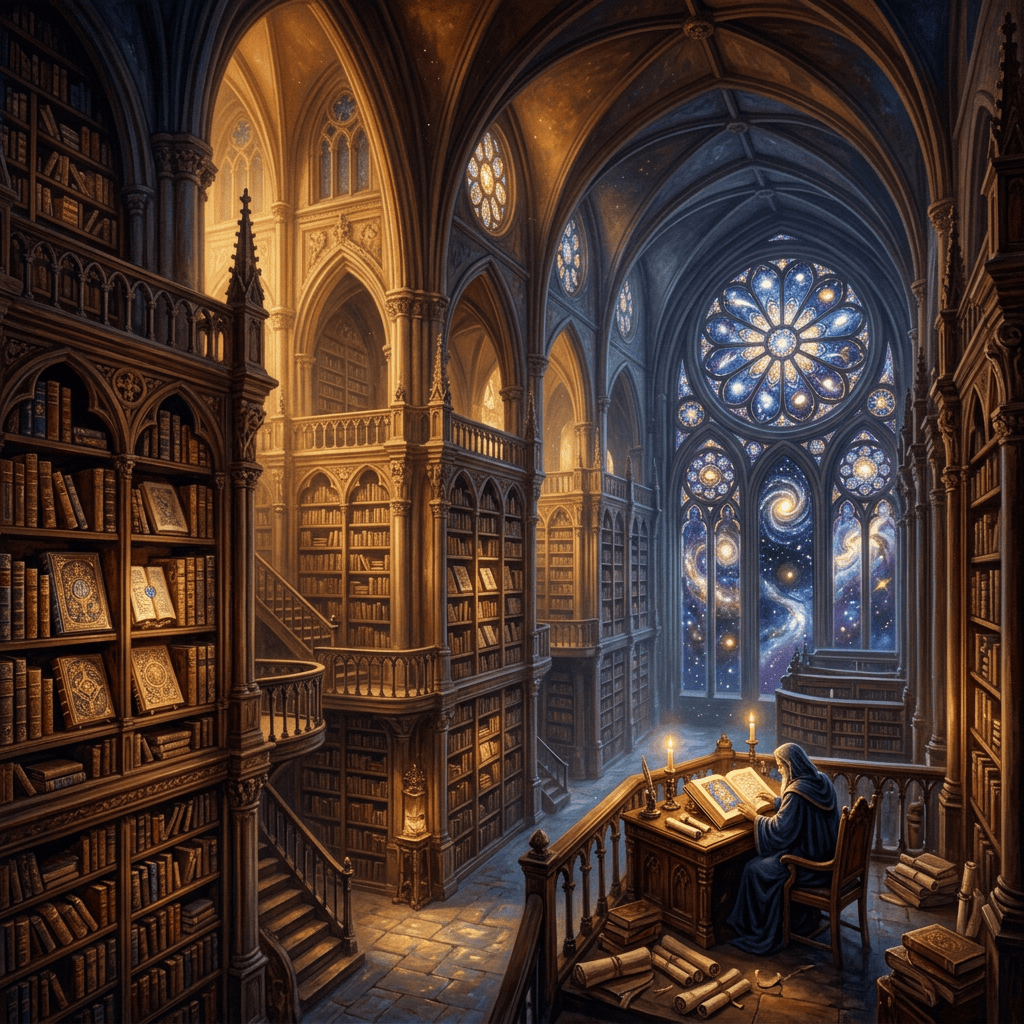
Scholar reading an illuminated manuscript in a Gothic library with cosmic stained-glass windows
A scholar studies an illuminated manuscript in a vast Gothic library glowing beneath cosmic stained-glass windows.

There is a story behind my series Ancient Sacred Texts and the Mystical Scriptorium that is difficult to explain within the ordinary categories of publishing. Some of these books are exactly what their titles suggest: ancient sacred texts and historical spiritual writings that have survived through the centuries and which I have compiled, edited, interpreted, or introduced for modern readers. But not all of them are ancient texts in the conventional sense. Some are texts I encountered during out-of-body experiences in what I have come to call the Mystical Scriptorium—a vast spiritual library or repository existing in the mystical spheres. In those experiences, I encountered books and teachings that, as far as I understand them, have not yet been written or published here in the physical world. I experienced them there, inhaled them there, and then exhaled them back into this world through the written word. That is the mystery at the heart of this series.

What Is the Mystical Scriptorium?

During my out-of-body travels, I have encountered many different spiritual environments: sacred places, teachers, monasteries, temples, beings of light, and realms that seem to possess their own particular qualities and purposes. Among these experiences was the encounter with what I call the Mystical Scriptorium. The word scriptorium traditionally refers to a place where manuscripts are copied and preserved. In the mystical sense, however, the Scriptorium became something much larger in my experience—a place of spiritual knowledge, sacred texts, wisdom, revelation, and writings that seemed to exist beyond the boundaries of ordinary physical history.

There were books there, not simply books in the way we understand them on Earth, but repositories of consciousness and knowledge. Sometimes, I was able to encounter their contents and bring something of what I had experienced back with me. This is where the unusual nature of some of these books begins. They are not presented as ordinary historical reconstructions. They come from a different kind of encounter with sacred knowledge. They represent my attempt to give physical form to something first encountered in a spiritual dimension.

Ancient Texts and Future Texts

There is an important distinction within this collection. Several of the books belong to the ancient textual traditions of our physical world. These include works such as The Western Book of the Dead: Or the Record of the Books of God, The Divine Pymander and the Emerald Tablets of Thoth Hermes Trismegistus, and The Shepherd of Hermas. The series also includes The Cherubinic Wanderer, by Angelus Silesius, and The Vow and Aspiration of Mahamudra, associated with Garmapa Dorje. These works belong to the enormous historical treasury of sacred literature that humanity has preserved, and my work with them involves bringing these traditions into a form that can be explored by contemporary readers.

But alongside them are books of a different character. The Sutra of the Ounce is one example, while Mercy: The Path to Becoming Holy, The Siddhartha Tragedies: A Visionary Scripture of the Near Awakened, and The Cult of Nefertiti belong to the body of works that emerged from my own mystical explorations and spiritual writing. These are not simply attempts to reproduce something already sitting in an ancient manuscript collection somewhere on Earth. They are part of an ongoing mystical transmission, representing knowledge that I believe I encountered in the mystical realms and subsequently brought into physical form through writing.

In that sense, some of these books might be understood as ancient in the mystical realms but new to the physical world. That distinction is important because it changes the way we might think about sacred literature itself. We tend to imagine an ancient sacred text as something that must have been written thousands of years ago on Earth, preserved in a manuscript, carved into stone, or passed down through generations. But mystical experience suggests another possibility: that sacred knowledge may exist beyond our ordinary understanding of historical time, and that what is ancient from one perspective may still be newly entering human consciousness from another.

The Scriptorium as a Bridge

I have often felt that one of the purposes of mystical experience is to create a bridge between worlds. We tend to think of revelation as something that happened only in the distant past. We read about prophets, apostles, saints, mystics, sages, and visionaries who received knowledge through dreams, visions, contemplation, prayer, or extraordinary states of consciousness. But what if the movement of sacred knowledge has never actually stopped? What if there are dimensions of spiritual reality in which knowledge continues to exist, develop, and be preserved? What if some books have existed there long before they ever appear here?

The Mystical Scriptorium, as I experienced it, suggested precisely this possibility. My role was not necessarily to create the knowledge; sometimes it felt more like receiving it. The experience was one of entering, encountering, absorbing, and then returning. I like to describe that process as inhaling and exhaling: I inhaled the book in the mystical spheres, carried something of it back with me, and then exhaled it into the physical world.

This way of understanding the work also changes the meaning of authorship. There are books in this collection that I have written in the conventional sense, and there are others where my role feels more like that of a receiver, interpreter, compiler, or transmitter. The physical book bears my name because I am the person who brought it into physical form, but the origin of the inspiration or material may belong to a much larger spiritual experience.

Not Every Book Has the Same Origin

The collection is intentionally broad because my work has never been confined to one category of spiritual literature. Some books are ancient texts. Some are mystical transmissions. Some are theological commentaries. Some explore religious history. Some examine the writings of particular spiritual traditions. And some emerge directly from my own mystical experiences and contemplative work.

For example, The Mystics of Christianity: Saints, Visionaries, and Forgotten Masters of Divine Encounter is a work of Christian mystical history and exploration, bringing together the lives and teachings of Christian mystics across the centuries. The Silent Desert of the Soul explores the Rule, Statutes, and Diurnal of the Carthusian Order through theological and contemplative commentary. The Buddha’s Three White Energies approaches Buddhist teachings through the Tripitaka, while The Cosmic Blueprint of Kriya Yoga examines Paramahamsa Yogananda’s early lessons. And then there is Pensatia: Present Balance – The Mystical Teachings of Helen Merrick Bond, which represents yet another dimension of the project: preserving and exploring a body of mystical teaching and spiritual thought.

These books may look different from one another, but spiritually they belong together. They are all concerned with the same fundamental question: What is humanity capable of knowing about the Divine? Some approach that question through history. Others approach it through sacred scripture. Others emerge from mystical experience, contemplative inquiry, or the transmission of teachings that seem to originate beyond the physical world. Together, they create a much broader picture of the human search for God, Truth, wisdom, holiness, and spiritual reality.

The Forgotten, the Ancient, and the Not-Yet-Written

Perhaps the best way to understand the series is to think of it as standing at the meeting point of three worlds. There is the ancient—the sacred literature humanity has already received and preserved. There is the mystical—the knowledge encountered through direct spiritual experience, contemplation, and out-of-body travel. And there is the not-yet-written—knowledge that may exist beyond our present historical moment but has not yet entered the physical literary record.

The Mystical Scriptorium, in my experience, seemed to exist outside our ordinary understanding of time. That makes the idea of an “ancient” book rather different. A book can be ancient in one realm and new in another. A teaching can be timeless even if it has not yet been written down. And a manuscript can exist as spiritual reality before it exists as ink upon paper. That is the extraordinary possibility behind this collection.

This also helps explain why the books do not all look or feel alike. The series is not attempting to force every work into one category or one historical framework. Instead, it follows the different streams through which sacred knowledge has reached humanity—or, in some cases, through which I believe I have encountered it.

Why Bring These Books Back?

The question naturally arises: why bring them back at all? For me, the answer is simple: because sacred knowledge is meant to be shared. Throughout history, people have gone into deserts, caves, monasteries, mountains, temples, forests, and places of solitude seeking something beyond the ordinary world. They have returned with prayers, scriptures, teachings, poetry, visions, and stories. The mystical tradition has always been concerned with transmission. One person encounters something, brings it back, writes it down, and someone else reads it, allowing the encounter to begin again.

Perhaps my work is simply another expression of that ancient process. The difference is that some of the places from which these encounters arise are not physical places, and some of the books encountered there do not appear to have corresponding physical manuscripts in our world. The act of writing then becomes a bridge between the experience and the reader—a way of giving language and form to something that was first encountered beyond ordinary physical consciousness.

A Mystical Library for the Present Age

The series Ancient Sacred Texts and the Mystical Scriptorium is therefore more than a collection of books about religion. It is a library of encounters containing ancient voices and modern interpretations, historical traditions and mystical experiences, established sacred writings and writings that, in my experience, seem to have come from beyond the physical boundaries of our present world.

The collection includes works ranging from The Western Book of the Dead and The Divine Pymander to The Mystics of Christianity, The Buddha’s Three White Energies, The Silent Desert of the Soul, The Cosmic Blueprint of Kriya Yoga, The Vow and Aspiration of Mahamudra, The Shepherd of Hermas, The Cherubinic Wanderer, The Sutra of the Ounce, Mercy, The Siddhartha Tragedies, The Cult of Nefertiti, Pensatia, and The Lost Books of the Essenes. Each book has its own story, and each comes from a different doorway, yet all of them ask the reader to consider the possibility that our understanding of sacred literature may be much larger than we have imagined.

The Scriptorium Remains Open

I do not think of the Mystical Scriptorium as merely a place I visited in the past. In some sense, I believe it remains open. Perhaps the great spiritual libraries of existence are not closed archives. Perhaps they are living repositories, continually revealing themselves to those who seek with sincerity, humility, and a willingness to listen.

The books that have emerged from this journey are my attempt to listen. Some came from ancient Earth. Some came through mystical study and contemplation. Some came through direct mystical experience. And some, I believe, came from books that already existed somewhere beyond this physical world, waiting for the moment when they could be brought across the threshold.

I did not set out to create a series quite like this. It evolved through the journey itself. One book led to another, one mystical encounter opened another door, and one ancient tradition illuminated another. Eventually, all of these books began to look like parts of the same library: the Ancient Sacred Texts and the Mystical Scriptorium.

A library of what humanity has remembered, what the mystics have encountered, and perhaps even what humanity has yet to remember.

The Scriptorium is open. The books are waiting. And the journey continues.

The Lost Books of the Essenes: A Mystical Interpretation of the Dead Sea Scrolls

BY MARILYNN HUGHES

The Lost Books of the Essenes: A Mystical Interpretation of the Dead Sea Scrolls

By Marilynn Hughes

What happens when an ancient spiritual world, long hidden from ordinary awareness, suddenly opens itself again? In a mystical experience, Marilynn Hughes was sitting within a mystical sphere playing guitar when approximately thirty hooded monks began emerging from an ancient jar positioned before her. She immediately recognized them as Essenes. One monk stepped forward and quietly placed a book into her hands, its title, The Lost Books of the Essenes. Later, after she had returned to her physical body, a single hooded monk appeared beside her bed, standing in prayer over her sleeping soul before slowly disappearing as consciousness returned.

That experience opened an extraordinary encounter with the spiritual world surrounding the Essenes and the writings preserved among the Dead Sea Scrolls. Rather than approaching these ancient manuscripts solely as archaeological discoveries or historical artifacts, The Lost Books of the Essenes: The Dead Sea Scrolls explores the spiritual path that emerges from their world: the pursuit of purity, sacred discipline, Divine order, heavenly worship, revelation, spiritual discernment, and the movement from ordinary awareness toward a deeper receptivity to God.

The Dead Sea Scrolls preserve a remarkable body of ancient Jewish literature, including biblical manuscripts, prayers, hymns, legal and communal writings, commentaries, calendrical texts, apocalyptic works, and mystical visions dating largely from the Second Temple period. The community associated with Qumran has traditionally been identified with the Essenes, although the precise relationship between the settlement, its inhabitants, and the wider Essene movement remains a matter of scholarly discussion. Within that historical mystery lies a spiritual mystery: what kind of people would devote themselves so completely to purification, communal discipline, sacred study, prayer, and preparation for Divine fulfillment?

The Essene path reveals a vision in which spiritual knowledge is not merely something to acquire, but something for which the human being must become prepared. Purification clears what obscures perception. Discipline gives steadiness to intention. Awakening allows what was previously unseen to become perceptible. Opening makes the heart receptive to what cannot be forced. Illumination allows hidden meaning to become inwardly clear, while alignment brings one’s life into greater correspondence with what has been recognized. Surrender releases the need to control Divine revelation, and receiving allows what cannot be manufactured through human effort to enter consciousness.

Within the writings and traditions surrounding the Dead Sea Scrolls are profound explorations of Light and Darkness, the Two Spirits, angels and heavenly realms, sacred time, communal holiness, ritual and inner purity, the mysteries of creation, Divine revelation, and the anticipated fulfillment of God’s purposes. These themes reveal a spiritual vision in which the visible world is not regarded as the whole of reality and the human being is capable of a deeper relationship with the Divine through purification, attention, prayer, and openness.

Yet the deepest mystery may not be found in any single manuscript. It may be found in the possibility that the ancient writings were preserving more than information. They were preserving a way of approaching existence, a discipline of consciousness, and a vision of what becomes possible when the heart is prepared to recognize Divine reality. The caves may have concealed the manuscripts for centuries, but the questions they contain remain remarkably alive: What must be cleared within us before we can see clearly? What must become quiet before we can hear? What must be surrendered before we can receive? And what might become possible when the heart is opened to the Light?

The Lost Books of the Essenes: The Dead Sea Scrolls invites the ancient world of Qumran into a living mystical encounter, bringing together the forgotten writings, the spiritual disciplines, the mysteries of Light and Darkness, and the deeper question of what it means to prepare the human being for Divine presence. It is a journey into a world that disappeared from ordinary history but whose spiritual questions remain capable of opening something within us today.

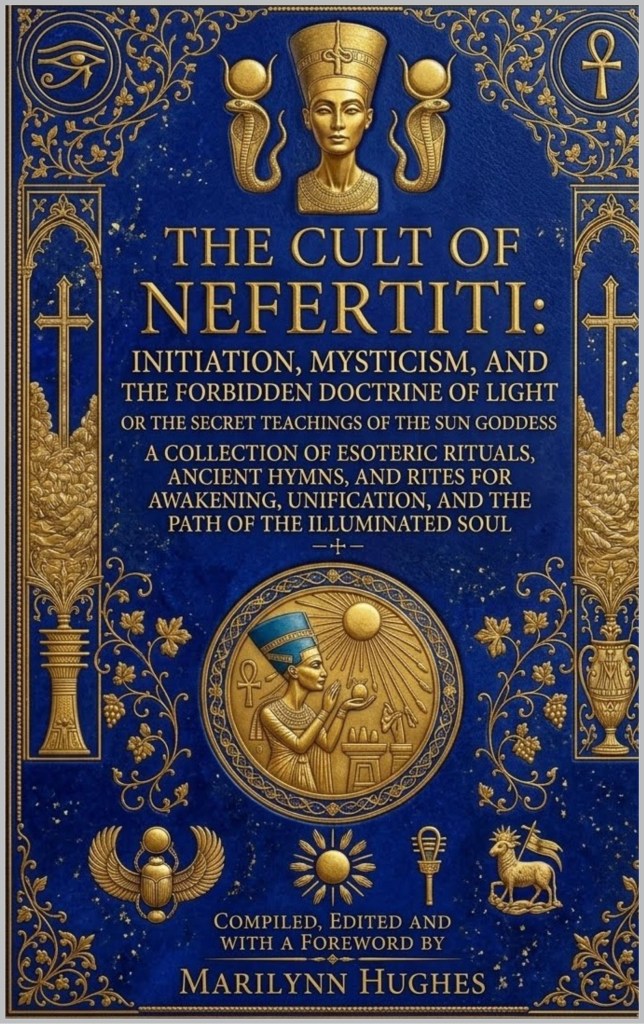
The Cult of Nefertiti: Initiation, Mysticism, and the Forbidden Doctrine of Light

BY MARILYNN HUGHES

The Cult of Nefertiti: Initiation, Mysticism, and the Forbidden Doctrine of Light

By Marilynn Hughes

The Cult of Nefertiti: Initiation, Mysticism, and the Forbidden Doctrine of Light, By Marilynn Hughes – A Collection of Esoteric Rituals, Ancient Hymns and Rites for Awakening, Unification and the Path of the Illuminated Soul The Cult of Nefertiti is a profound work of esoteric apocrypha and comparative Egyptian theology. Written, compiled, and edited by Marilynn Hughes, the book presents a meticulously reconstructed master system of Solar Gnosticism that traces the evolution of the soul’s relationship with raw creation. Moving beyond traditional anthropomorphic gods and institutionalized priesthoods, the text serves as a transformative map across six distinct volumes and seventeen liturgical books. It seamlessly bridges the absolute roots of ancient mysticism—weaving the cosmic ascension formulas of the Old Kingdom Pyramid Texts, the out-of-body transition keys of the New Kingdom Book of the Dead, the revolutionary solar heresy of the Amarna Period, and the final, high intellectual philosophy of the Corpus Hermeticum. The narrative structure guides the practitioner step-by-step through a complete spiritual transmutation: • The Descent and Dissolution: The book opens in the depths of an underground unlit chamber, forcing the initiate to shed worldly names, social identities, and egoic illusions through the grueling energetic trial of the Seven Veils. • The Alignment of Power: It introduces the sacred principle of Divine Symmetry, using the historical figures of Akhenaten and Queen Nefertiti as cosmic archetypes to balance the active and receptive halves of the human soul. • The Living Solar Heresy: It reveals the core “Forbidden Doctrine”—the radical realization that the Divine is not hidden inside dark temples, but is fully visible as an uncreated cosmic intelligence of light vibrating directly within the cell and marrow of human anatomy. • The Ultimate Synthesis: The text reaches its climax by reconciling the greatest paradox of Egyptian mysticism, showing the seeker how to find the brilliant “Midnight Sun” hidden at the absolute center of the underworld tomb. Concluding with direct, sovereign instructions from Queen Nefertiti and practical master seals, this codex acts as both an esoteric masterwork and a practical meditative guidebook. It is designed for modern seekers who wish to break free from external religious structures, claim their spiritual birthright, and anchor the unyielding light of cosmic truth within their daily walk.

The Mystics of Christianity:

Saints, Visionaries, and Forgotten Masters of Divine Encounter

BY MARILYNN HUGHES

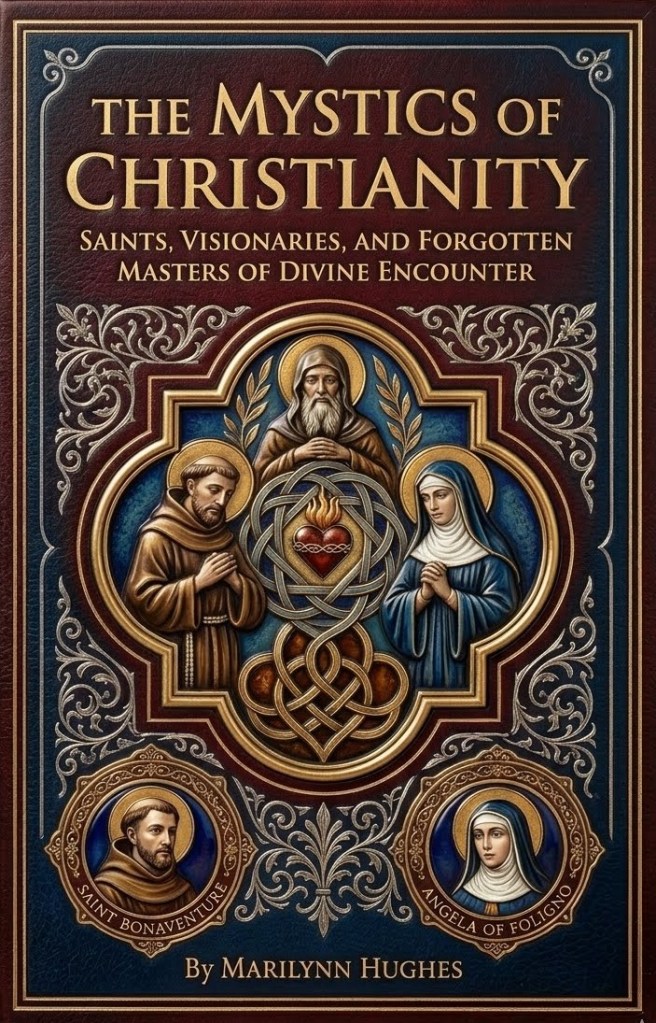
The Mystics of Christianity: Saints, Visionaries, and Forgotten Masters of Divine Encounter

By Marilynn Hughes

The Mystics of Christianity: Saints, Visionaries, and Forgotten Masters of Divine Encounter, By Marilynn Hughes – The Mystics of Christianity is a comprehensive exploration of the Christian mystical tradition, bringing together the voices of saints, contemplatives, theologians, visionaries, monastics, and spiritual seekers whose lives and writings have revealed the profound depths of the soul’s journey toward God. From the early Desert Fathers and Mothers to the great mystics of the medieval world and the continuing witnesses of modern contemplation, this volume traces the unfolding of a spiritual tradition that has sought not only to understand God, but to encounter the Divine through prayer, silence, surrender, love, and transformation. Within these pages are the familiar masters of Christian mysticism as well as lesser-known figures whose wisdom has often remained hidden from wider audiences. Together, they reveal the many expressions of mystical experience: the longing for union with God, the purification of the heart, the discovery of divine love, the mystery of creation, the transformation born through suffering, and the awakening of the human person to a deeper reality. More than a collection of biographies, The Mystics of Christianity is a journey through the living history of Christian spiritual experience. It invites readers to encounter the voices of those who sought the mystery beyond words and discovered that the deepest movement of the soul is always a movement toward Divine Love. Featuring the lives, writings, and spiritual insights of Jesus of Nazareth, Mary, Paul the Apostle, Ignatius of Antioch, Anthony the Great, Augustine of Hippo, Pseudo-Dionysius the Areopagite, Isaac of Nineveh, Symeon the New Theologian, Hildegard of Bingen, Bernard of Clairvaux, Francis and Clare of Assisi, Mechthild of Magdeburg, Hadewijch of Antwerp, Meister Eckhart, Julian of Norwich, Catherine of Siena, Teresa of Ávila, John of the Cross, Brother Lawrence, Angelus Silesius, Thérèse of Lisieux, Elizabeth of the Trinity, Charles de Foucauld, Thomas Merton, James Finley, Hermas, Perpetua, Anne Catherine Emmerich, and hundreds of other saints, visionaries, contemplatives, theologians, monastics, and forgotten masters, this volume offers one of the most comprehensive explorations of the Christian mystical tradition ever assembled in a single work.

Mercy: The Path to Becoming Holy

BY MARILYNN HUGHES

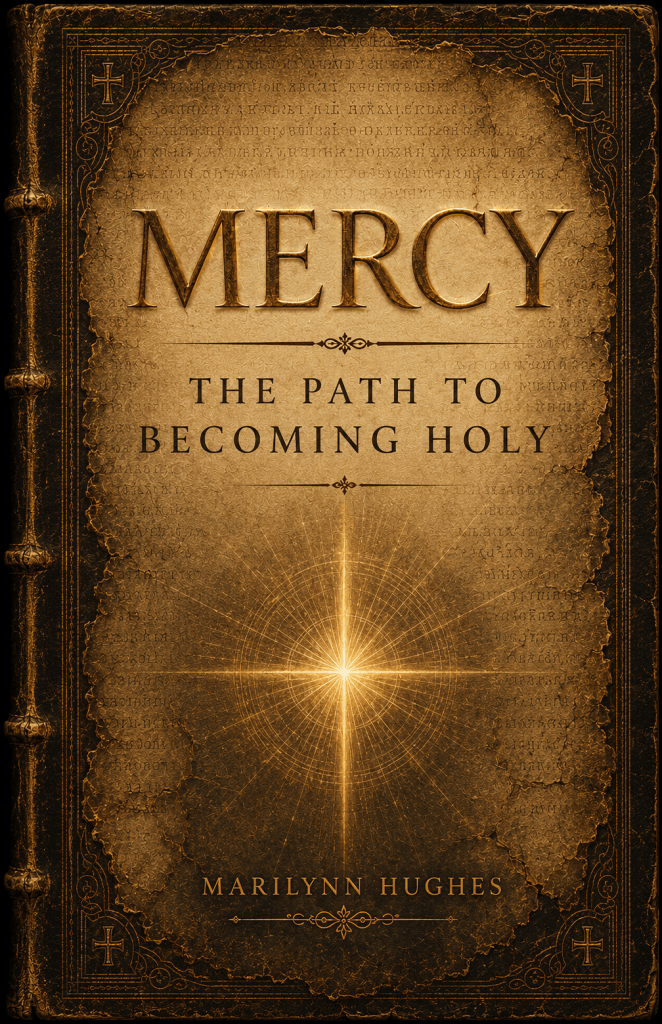
Mercy: The Path to Becoming Holy

By Marilynn Hughes

There is a power that does not destroy in order to rule. It does not overwhelm the soul to break it. It does not withdraw when the soul is weakest. It remains. This power is God’s mercy.

In Mercy: The Path to Becoming Holy, mercy is revealed not as sentiment or abstraction, but as a living divine force that enters the deepest places of human struggle—where identity has hardened, where hope has collapsed, where suffering has become internalized and silent.

This is not a philosophy of consolation. It is a testimony to transformation.

Across the movements of this inquiry, the soul is shown in its many states: bound by inner chains it no longer recognizes, lost within spiritual darkness, pressed by despair, and burdened by suffering it cannot resolve through will alone. And yet, in each condition, mercy is present—not as explanation, but as presence; not as theory, but as action within the soul itself.

Mercy does not wait for the soul to become worthy. It moves first.

It loosens what has become fixed. It enters what has become closed. It remains where the soul believes it is beyond reach. And through this quiet, unwavering presence, something begins to change from within: identity softens, perception opens, despair loses final authority, and what once felt unchangeable begins to yield.

In this vision, holiness is not presented as distance from human weakness, but as the transformation of the soul through sustained contact with divine mercy. Freedom is not escape from life, but liberation within it. And love is not distant ideal—it is the active power shaping reality from within.

Ultimately, this inquiry invites the reader into a single realization that changes everything:

Mercy is not something the soul reaches toward.

It is the divine power that reaches into the soul—and does not let it go.

The Ever-Present Christ: Encounters from the First Century to Today

Signature: eP384JYSh4xmsSKq1gj9nywlFPO08DVjz2T4hTFg40cVGcAVp0OwwIead9ltWbfAM8kuLJgIZ6GzO48nY9FOj/KaPcDTKpGFbeUmUmZI7EG/dQDkNo2UKJGW0i3nHlp9KBWyVqiT7BljBk7tmH2SWIt+9l/HeE/4RXB+w7KhO/Q=

By Marilynn Hughes

Many ask, “If Jesus Christ rose from the dead, where is He now? Why has no one seen Him for over two thousand years?” The answer lies not in disbelief, but in understanding the nature of Christ, God incarnate, and the ongoing testimony of His presence in the world.

Jesus is unique among all religious leaders. He is both fully divine and fully human—“begotten, not made”—as the Creed of Nicaea affirms. He is eternal, perfect, yet also walked this earth in flesh, experiencing growth, emotion, and death. Over three hundred Old Testament prophecies were fulfilled in Him alone—a reality so extraordinary it points unmistakably to the divine.

After His resurrection, Christ appeared repeatedly to His disciples and to hundreds of witnesses, before ascending to Heaven. Their unwavering testimony, even under threat of torture, attests to the reality of the Resurrection. And since His Ascension, Christ continues to manifest in countless ways, in visions and apparitions, guiding, consoling, and inspiring humanity.

Christ’s resurrected form is different from the one who walked Galilee. He now exists fully in divine glory, incomprehensible yet intimately present to those He loves. His appearances are not bound by time, space, or human expectation—they occur wherever, whenever, and however He wills.

The Catholic Church has recognized numerous verified apparitions throughout history:

  • 36 AD: Saint Stephen sees Christ standing at God’s right hand before his martyrdom.
  • 31–36 AD: Saul, later Saint Paul, encounters Christ on the road to Damascus, transforming from persecutor to apostle.
  • 1205: Saint Francis of Assisi receives a vision calling him to repair the Church, leading to the formation of the Franciscan order.
  • 1246: Saint Lutgarde experiences a mystical exchange of hearts with Christ, fostering devotion to His Sacred Heart.
  • 1302–1366: Saints Gertrude the Great, Catherine of Siena, and others report transformative visions of Christ, shaping their lives and ministries.
  • 1673–1675: Saint Marguerite Marie Alacoque receives revelations of the Sacred Heart, inspiring a devotion celebrated to this day.
  • 19th–20th centuries: Figures such as Saint Pio of Pietrelcina, Sister Josefa Menendez, Saint Faustina Kowalska, and Sister Maria Pierina De Micheli experience intimate encounters with Christ, often accompanied by the miraculous, the stigmata, or divine instruction.

Even in modern times, Jesus continues to appear to the faithful. Ordinary believers, such as those in Rwanda during the 1980s or individuals recounting personal encounters, bear witness to His ongoing presence, guidance, and protection.

The lesson is clear: Jesus Christ is alive. His appearances may be subtle or overwhelming, private or public, but they are real. He speaks to those who seek Him, consoles the suffering, and prepares humanity for His eventual return.

Christ’s presence is not limited to the pages of Scripture or the distant past—it is here, now, in our hearts and in the world. To see Him, one must seek with openness, faith, and love, trusting that He will reveal Himself in the way and time He chooses.

Bible Verses to Comfort Yourself in Times of Loss

Courtesy of Tithely

Matthew 5:4: “Blessed are those who mourn, for they will be comforted.” Joshua 1:9: “Have I not commanded you? Be strong and courageous. Do not be afraid; do not be discouraged, for the Lord your God will be with you wherever you go.” Psalm 73:26: “My flesh and my heart may fail, but God is the strength of my heart and my portion forever.” Revelation 21:4: “He will wipe every tear from their eyes. There will be no more death or mourning or crying or pain, for the old order of things has passed away.” 2 Corinthians 4:17-18: “For our light and momentary troubles are achieving for us an eternal glory that far outweighs them all. So we fix our eyes not on what is seen, but on what is unseen, since what is seen is temporary, but what is unseen is eternal.” Romans 14:8: “If we live, we live for the Lord; and if we die, we die for the Lord. So, whether we live or die, we belong to the Lord.” John 16:22: “So with you: Now is your time of grief, but I will see you again and you will rejoice, and no one will take away your joy.” Psalm 116:15: “Precious in the sight of the Lord is the death of His faithful servants.” Romans 8:18: “I consider that our present sufferings are not worth comparing with the glory that will be revealed in us.” Psalm 23:4: “Even though I walk through the darkest valley, I will fear no evil, for you are with me; your rod and your staff, they comfort me.” 1 Thessalonians 4:13-14: “Brothers and sisters, we do not want you to be uninformed about those who sleep in death, so that you do not grieve like the rest of mankind, who have no hope. For we believe that Jesus died and rose again, and so we believe that God will bring with Jesus those who have fallen asleep in Him.” John 11:25-26: “Jesus said to her, ‘I am the resurrection and the life. The one who believes in me will live, even though they die; and whoever lives by believing in me will never die. Do you believe this?’” Matthew 11:28-30: “Come to me, all you who are weary and burdened, and I will give you rest. Take my yoke upon you and learn from me, for I am gentle and humble in heart, and you will find rest for your souls. For my yoke is easy and my burden is light.” Lamentations 3:32: “Though He brings grief, He will show compassion, so great is His unfailing love.” Psalms 147:3: “He heals the brokenhearted and binds up their wounds.” John 5:24-25: “Very truly I tell you, whoever hears my word and believes Him who sent me has eternal life and will not be judged but has crossed over from death to life. Very truly I tell you, a time is coming and has now come when the dead will hear the voice of the Son of God and those who hear will live.” Isaiah 25:8: “He will swallow up death forever. The Sovereign Lord will wipe away the tears from all faces; He will remove His people’s disgrace from all the earth. The Lord has spoken.” 1 Corinthians 15:21-22: “For since death came through a man, the resurrection of the dead comes also through a man. For as in Adam all die, so in Christ all will be made alive.” Romans 8:38-39: “For I am convinced that neither death nor life, neither angels nor demons, neither the present nor the future, nor any powers, neither height nor depth, nor anything else in all creation, will be able to separate us from the love of God that is in Christ Jesus our Lord.”