
By Marilynn Hughes
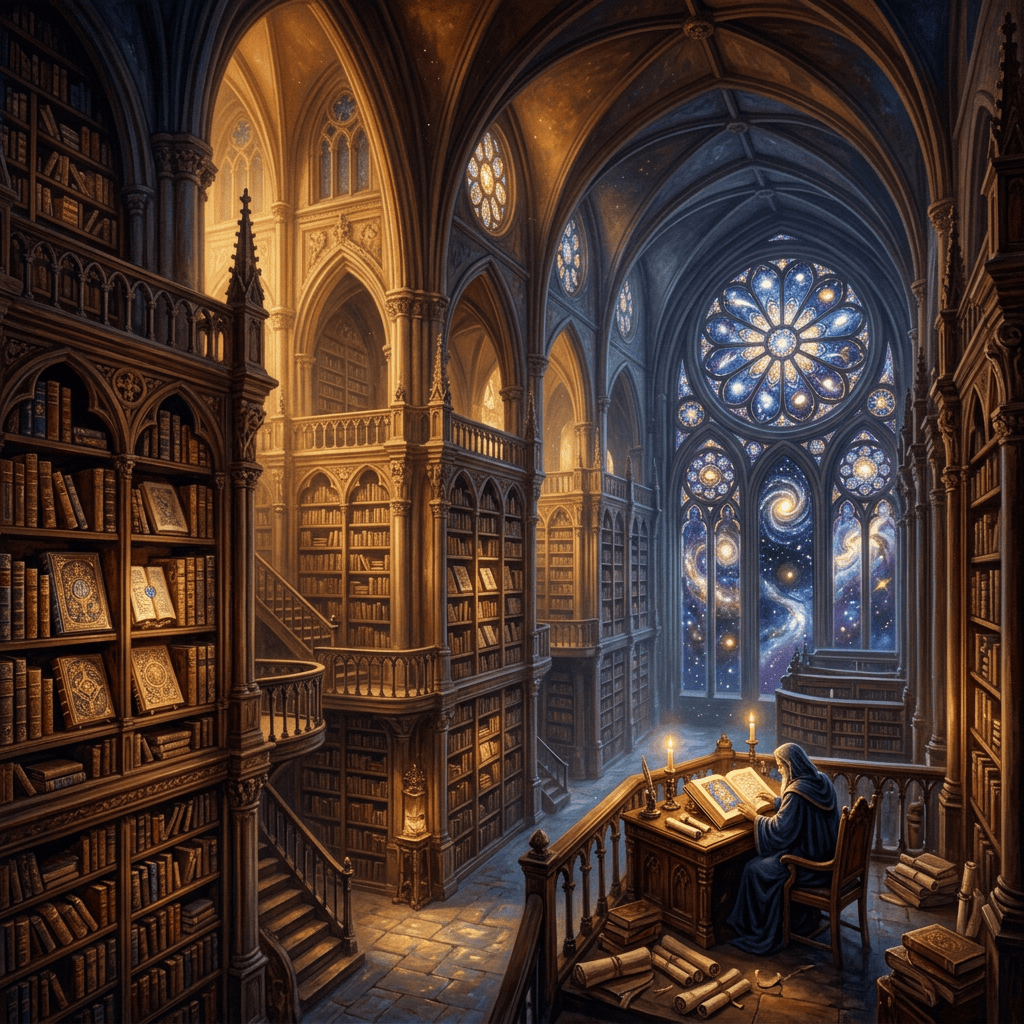
There is a story behind my series Ancient Sacred Texts and the Mystical Scriptorium that is difficult to explain within the ordinary categories of publishing. Some of these books are exactly what their titles suggest: ancient sacred texts and historical spiritual writings that have survived through the centuries and which I have compiled, edited, interpreted, or introduced for modern readers. But not all of them are ancient texts in the conventional sense. Some are texts I encountered during out-of-body experiences in what I have come to call the Mystical Scriptorium—a vast spiritual library or repository existing in the mystical spheres. In those experiences, I encountered books and teachings that, as far as I understand them, have not yet been written or published here in the physical world. I experienced them there, inhaled them there, and then exhaled them back into this world through the written word. That is the mystery at the heart of this series.
What Is the Mystical Scriptorium?
During my out-of-body travels, I have encountered many different spiritual environments: sacred places, teachers, monasteries, temples, beings of light, and realms that seem to possess their own particular qualities and purposes. Among these experiences was the encounter with what I call the Mystical Scriptorium. The word scriptorium traditionally refers to a place where manuscripts are copied and preserved. In the mystical sense, however, the Scriptorium became something much larger in my experience—a place of spiritual knowledge, sacred texts, wisdom, revelation, and writings that seemed to exist beyond the boundaries of ordinary physical history.
There were books there, not simply books in the way we understand them on Earth, but repositories of consciousness and knowledge. Sometimes, I was able to encounter their contents and bring something of what I had experienced back with me. This is where the unusual nature of some of these books begins. They are not presented as ordinary historical reconstructions. They come from a different kind of encounter with sacred knowledge. They represent my attempt to give physical form to something first encountered in a spiritual dimension.
Ancient Texts and Future Texts
There is an important distinction within this collection. Several of the books belong to the ancient textual traditions of our physical world. These include works such as The Western Book of the Dead: Or the Record of the Books of God, The Divine Pymander and the Emerald Tablets of Thoth Hermes Trismegistus, and The Shepherd of Hermas. The series also includes The Cherubinic Wanderer, by Angelus Silesius, and The Vow and Aspiration of Mahamudra, associated with Garmapa Dorje. These works belong to the enormous historical treasury of sacred literature that humanity has preserved, and my work with them involves bringing these traditions into a form that can be explored by contemporary readers.
But alongside them are books of a different character. The Sutra of the Ounce is one example, while Mercy: The Path to Becoming Holy, The Siddhartha Tragedies: A Visionary Scripture of the Near Awakened, and The Cult of Nefertiti belong to the body of works that emerged from my own mystical explorations and spiritual writing. These are not simply attempts to reproduce something already sitting in an ancient manuscript collection somewhere on Earth. They are part of an ongoing mystical transmission, representing knowledge that I believe I encountered in the mystical realms and subsequently brought into physical form through writing.
In that sense, some of these books might be understood as ancient in the mystical realms but new to the physical world. That distinction is important because it changes the way we might think about sacred literature itself. We tend to imagine an ancient sacred text as something that must have been written thousands of years ago on Earth, preserved in a manuscript, carved into stone, or passed down through generations. But mystical experience suggests another possibility: that sacred knowledge may exist beyond our ordinary understanding of historical time, and that what is ancient from one perspective may still be newly entering human consciousness from another.
The Scriptorium as a Bridge
I have often felt that one of the purposes of mystical experience is to create a bridge between worlds. We tend to think of revelation as something that happened only in the distant past. We read about prophets, apostles, saints, mystics, sages, and visionaries who received knowledge through dreams, visions, contemplation, prayer, or extraordinary states of consciousness. But what if the movement of sacred knowledge has never actually stopped? What if there are dimensions of spiritual reality in which knowledge continues to exist, develop, and be preserved? What if some books have existed there long before they ever appear here?
The Mystical Scriptorium, as I experienced it, suggested precisely this possibility. My role was not necessarily to create the knowledge; sometimes it felt more like receiving it. The experience was one of entering, encountering, absorbing, and then returning. I like to describe that process as inhaling and exhaling: I inhaled the book in the mystical spheres, carried something of it back with me, and then exhaled it into the physical world.
This way of understanding the work also changes the meaning of authorship. There are books in this collection that I have written in the conventional sense, and there are others where my role feels more like that of a receiver, interpreter, compiler, or transmitter. The physical book bears my name because I am the person who brought it into physical form, but the origin of the inspiration or material may belong to a much larger spiritual experience.
Not Every Book Has the Same Origin
The collection is intentionally broad because my work has never been confined to one category of spiritual literature. Some books are ancient texts. Some are mystical transmissions. Some are theological commentaries. Some explore religious history. Some examine the writings of particular spiritual traditions. And some emerge directly from my own mystical experiences and contemplative work.
For example, The Mystics of Christianity: Saints, Visionaries, and Forgotten Masters of Divine Encounter is a work of Christian mystical history and exploration, bringing together the lives and teachings of Christian mystics across the centuries. The Silent Desert of the Soul explores the Rule, Statutes, and Diurnal of the Carthusian Order through theological and contemplative commentary. The Buddha’s Three White Energies approaches Buddhist teachings through the Tripitaka, while The Cosmic Blueprint of Kriya Yoga examines Paramahamsa Yogananda’s early lessons. And then there is Pensatia: Present Balance – The Mystical Teachings of Helen Merrick Bond, which represents yet another dimension of the project: preserving and exploring a body of mystical teaching and spiritual thought.
These books may look different from one another, but spiritually they belong together. They are all concerned with the same fundamental question: What is humanity capable of knowing about the Divine? Some approach that question through history. Others approach it through sacred scripture. Others emerge from mystical experience, contemplative inquiry, or the transmission of teachings that seem to originate beyond the physical world. Together, they create a much broader picture of the human search for God, Truth, wisdom, holiness, and spiritual reality.
The Forgotten, the Ancient, and the Not-Yet-Written
Perhaps the best way to understand the series is to think of it as standing at the meeting point of three worlds. There is the ancient—the sacred literature humanity has already received and preserved. There is the mystical—the knowledge encountered through direct spiritual experience, contemplation, and out-of-body travel. And there is the not-yet-written—knowledge that may exist beyond our present historical moment but has not yet entered the physical literary record.
The Mystical Scriptorium, in my experience, seemed to exist outside our ordinary understanding of time. That makes the idea of an “ancient” book rather different. A book can be ancient in one realm and new in another. A teaching can be timeless even if it has not yet been written down. And a manuscript can exist as spiritual reality before it exists as ink upon paper. That is the extraordinary possibility behind this collection.
This also helps explain why the books do not all look or feel alike. The series is not attempting to force every work into one category or one historical framework. Instead, it follows the different streams through which sacred knowledge has reached humanity—or, in some cases, through which I believe I have encountered it.
Why Bring These Books Back?
The question naturally arises: why bring them back at all? For me, the answer is simple: because sacred knowledge is meant to be shared. Throughout history, people have gone into deserts, caves, monasteries, mountains, temples, forests, and places of solitude seeking something beyond the ordinary world. They have returned with prayers, scriptures, teachings, poetry, visions, and stories. The mystical tradition has always been concerned with transmission. One person encounters something, brings it back, writes it down, and someone else reads it, allowing the encounter to begin again.
Perhaps my work is simply another expression of that ancient process. The difference is that some of the places from which these encounters arise are not physical places, and some of the books encountered there do not appear to have corresponding physical manuscripts in our world. The act of writing then becomes a bridge between the experience and the reader—a way of giving language and form to something that was first encountered beyond ordinary physical consciousness.
A Mystical Library for the Present Age
The series Ancient Sacred Texts and the Mystical Scriptorium is therefore more than a collection of books about religion. It is a library of encounters containing ancient voices and modern interpretations, historical traditions and mystical experiences, established sacred writings and writings that, in my experience, seem to have come from beyond the physical boundaries of our present world.
The collection includes works ranging from The Western Book of the Dead and The Divine Pymander to The Mystics of Christianity, The Buddha’s Three White Energies, The Silent Desert of the Soul, The Cosmic Blueprint of Kriya Yoga, The Vow and Aspiration of Mahamudra, The Shepherd of Hermas, The Cherubinic Wanderer, The Sutra of the Ounce, Mercy, The Siddhartha Tragedies, The Cult of Nefertiti, Pensatia, and The Lost Books of the Essenes. Each book has its own story, and each comes from a different doorway, yet all of them ask the reader to consider the possibility that our understanding of sacred literature may be much larger than we have imagined.
The Scriptorium Remains Open
I do not think of the Mystical Scriptorium as merely a place I visited in the past. In some sense, I believe it remains open. Perhaps the great spiritual libraries of existence are not closed archives. Perhaps they are living repositories, continually revealing themselves to those who seek with sincerity, humility, and a willingness to listen.
The books that have emerged from this journey are my attempt to listen. Some came from ancient Earth. Some came through mystical study and contemplation. Some came through direct mystical experience. And some, I believe, came from books that already existed somewhere beyond this physical world, waiting for the moment when they could be brought across the threshold.
I did not set out to create a series quite like this. It evolved through the journey itself. One book led to another, one mystical encounter opened another door, and one ancient tradition illuminated another. Eventually, all of these books began to look like parts of the same library: the Ancient Sacred Texts and the Mystical Scriptorium.
A library of what humanity has remembered, what the mystics have encountered, and perhaps even what humanity has yet to remember.
The Scriptorium is open. The books are waiting. And the journey continues.

