
By Marilynn Hughes
When a beloved member of our Out-of-Body Travel Foundation community recently reached out to ask about An Unpublished Manuscript on Purgatory by Sister Mary of the Cross (originally recorded in French by Sister Marie de la Croix, or Sister M. de L. C.), it brought back vivid memories of studying this remarkable little volume several years ago. Across decades of out-of-body travel, comparative mystical research, and examining ancient sacred texts, certain accounts stand out not for theatricality, but for their sober, unflinching clarity regarding what awaits the soul after physical death. This 19th-century convent record is undeniably one of them.
The Historical Context and the Sixteen-Year Dialogue
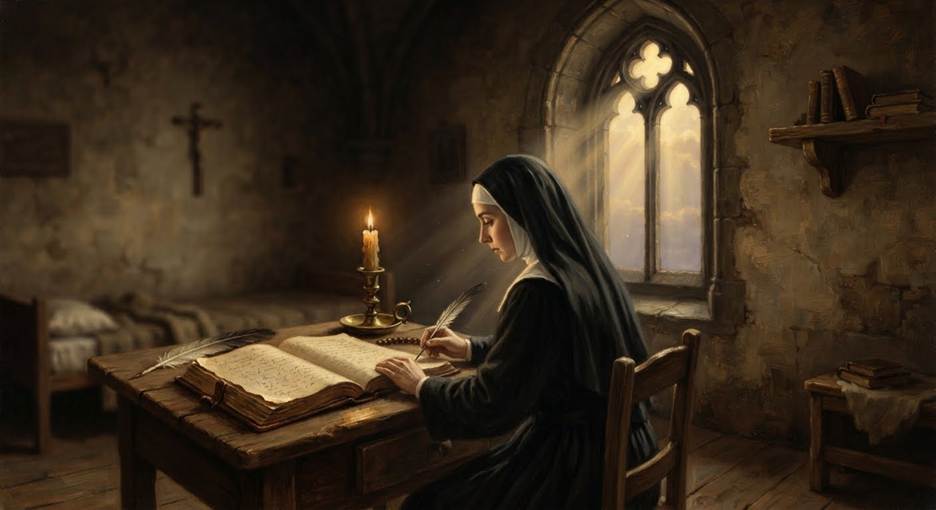
The origins of the text are rooted in quiet monastic life in Valognes, Normandy, France. In November 1873, Sister Mary of the Cross began hearing prolonged, sorrowful sighs right beside her in the convent. Initially frightened, she multiplied her prayers, Rosaries, and Ways of the Cross, pleading with the unseen presence not to show itself. Three months later, on February 15, 1874, a recognizable voice finally spoke to her, identifying herself as Sister Marie-Gabrielle—a fellow nun who had passed away at the age of thirty-six on February 22, 1871.
What makes their exchange so deeply instructive for students of spiritual law is why Sister Marie-Gabrielle was permitted to return to Sister Mary of the Cross. During her earthly life, Sister Marie-Gabrielle had frequently rejected and despised the spiritual counsel of this very sister. In the economy of divine justice and mercy, God allowed her to return from Purgatory to the exact companion she had once dismissed, both to seek her prayers and sacrifices for deliverance and to offer rigorous spiritual direction drawn from her own painful purification. For sixteen years, from 1874 until 1890, Sister Mary of the Cross faithfully transcribed these conversations in her notebooks, which were later examined by Catholic theologians and granted formal ecclesiastical approval (Nihil Obstat and Imprimatur) as an edifying historical testimony.
The Three Realms of Purification
One of the most compelling aspects of the manuscript—and one that aligns closely with broader mystical accounts of the intermediate spheres—is Sister Marie-Gabrielle’s firsthand cartography of Purgatory. Having passed through its degrees herself, she describes Purgatory not as a single uniform room, but as a tiered state of purification divided into three primary levels:
- The Great Purgatory (The Lowest Level): Located near the center of the earth close to Hell, this deepest stage consists of several degrees of intense fire and profound darkness. Here reside souls who committed grave sins during life and were saved almost miraculously at the final moment through last-minute contrition—often won through the persistent prayers of pious parents or loved ones. In this lowest tier, souls are deprived of any vision of the Blessed Virgin Mary and endure what Sister Marie-Gabrielle calls a temporary hell of acute torment.
- The Second Level: This realm holds souls who died with unexpiated venial sins, forgiven mortal sins for which full satisfaction had not yet been made, or long years of spiritual indifference and tepidity. Here the suffering is less severe than in the abyss below, and souls are granted occasional, consoling glimpses of the Blessed Mother. Notably, Sister Marie-Gabrielle emphasizes a sobering truth echoed across mystical theology: consecrated souls, priests, and those who received abundant spiritual graces on earth undergo a much longer and stricter purification here than ordinary laypeople, because far more was entrusted to them.
- The Purgatory of Desire (The Threshold): The highest stage contains no purifying fire at all. Instead, its martyrdom is purely interior—an insatiable, agonizing longing for the Beatific Vision of God while remaining held back by subtle residual imperfections. As Sister Marie-Gabrielle explains, very few souls escape this threshold, because avoiding it entirely requires an ardent, consuming desire for Heaven and complete detachment from earthly self-will prior to death.
Key Spiritual Takeaways for Seekers Today
Beyond its structure of the afterlife, An Unpublished Manuscript on Purgatory reads as a manual on interior purification and the power of intercession. Several core teachings from Sister Marie-Gabrielle’s dialogues remain profoundly relevant for anyone walking a serious contemplative path:
- The Deprivation of God Is the True Torment: While the lower spheres involve searing purification, the manuscript insists that the supreme agony of Purgatory is the absence of God—knowing Him with crystal clarity after death, yearning for Him with the full weight of the soul, and realizing that one’s own unpurified attachments are what bar the door.
- Time Beyond the Body: Sister Marie-Gabrielle notes that while earthly calculations might place an average stay at thirty or forty years—and longer for negligent consecrated souls—time is experienced entirely differently outside the body. Having been in Purgatory for eight earthly years at the time of one dialogue, she remarked that it felt to her like ten thousand.
- The Power of the Living to Relieve the Dead: Souls in Purgatory have their wills completely united to God, yet they are powerless to merit relief for themselves; they depend entirely on the charity of the living. Throughout the sixteen years of visits, Sister Marie-Gabrielle repeatedly testifies to the extraordinary power of the Holy Mass, Eucharistic adoration, and the Way of the Cross to shorten a soul’s exile, adding that God frequently grants immense graces to the living through the grateful intercession of the Holy Souls they help release.
- Self-Renunciation and Present Vigilance: Perhaps her most urgent counsel to Sister Mary of the Cross—and to every reader—is to live entirely for God in the present moment rather than clinging to earthly reputation, personal comforts, or self-will. As she warns in one of the manuscript’s most memorable passages, everything on earth passes swiftly, and only what is done in pure love for God endures into eternity.
For anyone studying the mechanics of the afterlife, the purification of the soul, or the communion between the living and the departed, An Unpublished Manuscript on Purgatory remains a deeply sobering and luminous read—one that invites us to purify our intentions today rather than waiting for the fires of tomorrow.

