
By Marilynn Hughes
Following our look at Arthur Dee and his alchemical compilations, it is essential to turn to his father, John Dee (1527–1608/1609)—one of the most complex and widely misunderstood figures of the English Renaissance. Often reduced in popular culture to a caricature of a court magician, Dee was in reality a Cambridge-educated mathematician, navigator, astronomer, antiquarian, and deeply devout Christian mystic who spent his life seeking direct spiritual communion with the angelic realms.
For students of out-of-body travel, consciousness exploration, and ancient mystery traditions, Dee’s life offers a fascinating primary-source record of how a sixteenth-century scholar approached spiritual sight, non-physical communication, and sacred texts.
Trusted Advisor to Queen Elizabeth I
Long before his angelic experiments began, John Dee was one of the foremost scientific minds in England. Educated at St. John’s College, Cambridge, and later lecturing on Euclid’s geometry in Paris to packed halls, Dee returned to England where his expertise in mathematics, cartography, and astronomy brought him directly into the Tudor royal court.
When Queen Elizabeth I ascended the throne in 1558, Dee was summoned to calculate the most astrologically auspicious date for her coronation—selecting January 15, 1559. Over the next three decades, he served as the Queen’s trusted scientific advisor, navigational tutor to England’s maritime explorers (including Martin Frobisher and Sir Walter Raleigh), and early advocate for British maritime expansion—coining the term “British Empire” in his 1577 treatise General and Rare Memorials pertayning to the Perfect Arte of Navigation. Elizabeth frequently visited Dee’s home in Mortlake, consulting him on everything from calendar reform to diplomatic intelligence, famously signing his letters with “007”—representing the two eyes of the Queen watching out for him, accompanied by the number seven, long considered sacred in esoteric tradition.
The Greatest Library in Renaissance England
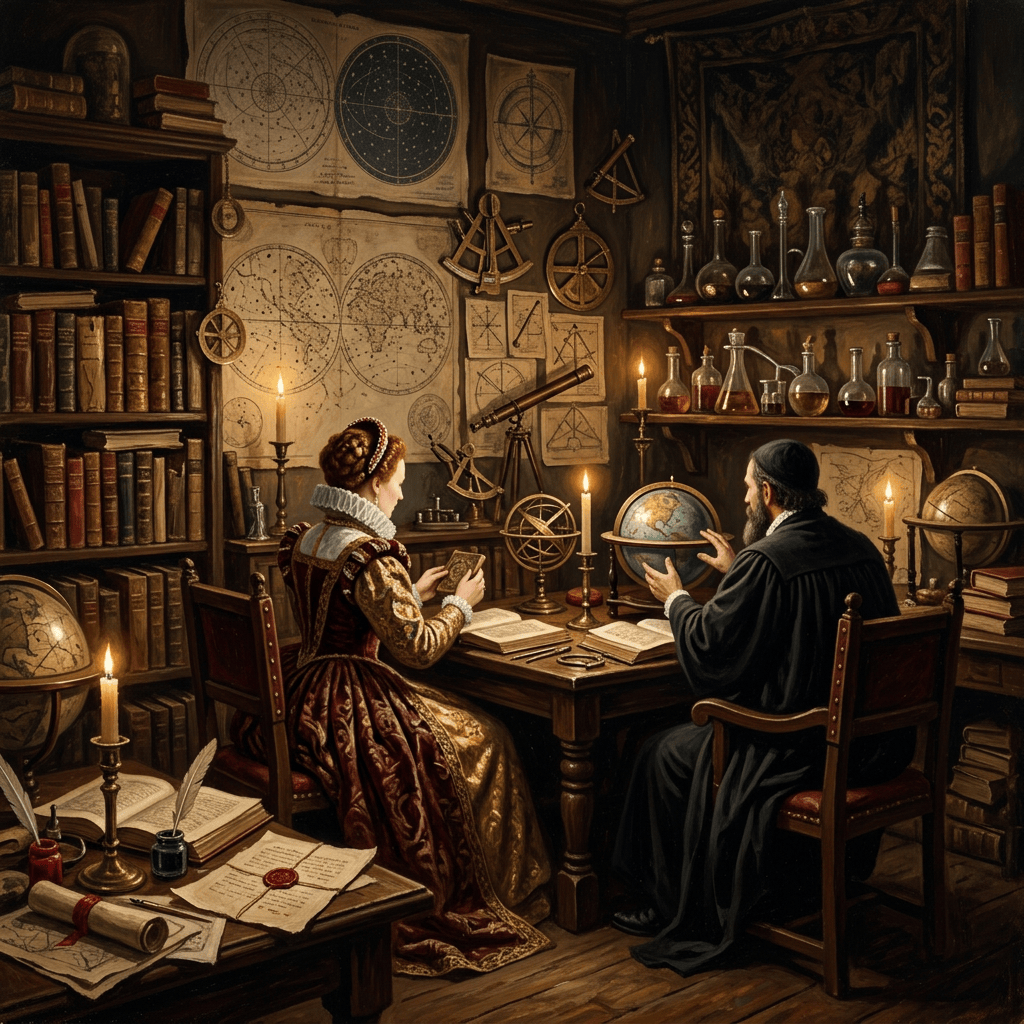
To understand John Dee’s spiritual work, one must first look at his extraordinary collection of books. At his residence in Mortlake along the River Thames, Dee assembled the largest private library in sixteenth-century England, housing an estimated 3,000 to 4,000 printed volumes and over 1,000 rare manuscripts—far surpassing the collections of Oxford and Cambridge universities at the time.
Cataloged in his own surviving 1583 inventory (Catalogus Bibliothecae Mortlacensis, preserved in the British Library and Trinity College, Cambridge), Dee’s shelves spanned mathematics, optics, navigation, ancient history, alchemy, Kabbalah, Hermeticism, and medieval angelology. He possessed rare manuscripts of Roger Bacon, Ramon Llull, Trithemius’s Steganographia, and Heinrich Cornelius Agrippa’s Three Books of Occult Philosophy.
For Dee, scientific inquiry and spiritual contemplation were never separate pursuits. In his 1564 treatise Monas Hieroglyphica (“The Hieroglyphic Monad”), he sought to unify astronomy, alchemy, and sacred geometry into a single symbolic key capable of elevating human consciousness toward divine understanding. Tragically, while Dee was traveling on the European continent between 1583 and 1589, a mob ransacked his Mortlake home, scattering and destroying hundreds of his irreplaceable manuscripts and scientific instruments.

The Angelic Diaries and the Enochian Alphabet
Despite his vast command of books, Dee came to believe that human scholarship alone could not unlock the highest spiritual truths—only direct instruction from God’s messengers could reveal the hidden architecture of creation. Because Dee himself did not possess natural clairvoyant or visionary sight, he worked with mediums—known as “scryers”—who gazed into a polished obsidian mirror or crystal showstone while Dee meticulously recorded every word spoken in his spiritual diaries.
Beginning in 1581 and continuing most intensively between 1582 and 1589 with his primary scryer, Edward Kelley, Dee documented hundreds of sessions. Today, these original manuscripts are preserved in the British Library (Cotton Appendix XLVI and Sloane MSS) and were later published in part by Meric Casaubon in 1659 as A True & Faithful Relation of What Passed for Many Years Between Dr. John Dee and Some Spirits.
During these sessions, Dee and Kelley recorded a complete, structured linguistic system dictated letter-by-letter and in reverse—known today as the Enochian Alphabet or “Angelic Language,” named after the biblical patriarch Enoch, who walked with God and was taken up into heaven without tasting death. Unlike random glossolalia, Enochian possessed its own 21-letter script, distinct grammar, syntax, and a series of 48 poetic invocations called the Calls or Keys, intended to align human consciousness with the thirty Aethyrs (or “Airs”)—hierarchical spiritual planes ascending outward from the physical earth toward the Divine Presence.
Relevance to Out-of-Body Travel and Consciousness Studies
For modern readers exploring out-of-body travel and astral projection, John Dee’s spiritual diaries are significant for several reasons:
- Mapping Non-Physical Realms (The Thirty Aethyrs): Much like out-of-body travelers and mystics throughout history who describe distinct vibrational planes or spheres beyond the physical body, Dee’s Liber Loagaeth and Liber Scientiae outline thirty concentric spiritual regions (Aethyrs), each governed by specific intelligences and experienced through elevated states of consciousness.
- The Role of Spiritual Discernment and Prayer: Dee’s diaries reveal a man who approached the non-physical world with intense religious reverence, fasting, and hours of daily prayer. Yet his records also serve as a cautionary study in discernment. When the spiritual communications eventually took an unsettling turn—culminating in Kelley claiming the spirits commanded them to share all possessions, including their wives, in 1587—Dee suffered deep spiritual anguish, illustrating the very real dangers of trusting unverified visionary experiences without strict moral and spiritual grounding.
- Bridging Sacred Text and Direct Experience: Dee never abandoned his Christian faith or his scholarly rigor. Even when his Mortlake library was plundered and his court favor faded in his later years, he continued to view his life’s work as a sacred quest to restore humanity’s original spiritual sight.
Whether viewed through the lens of Renaissance history, esoteric philosophy, or consciousness research, John Dee stands as a pivotal bridge between ancient textual wisdom and the direct exploration of the unseen realms.
By Marilynn Hughes
Following our look at Arthur Dee and his alchemical compilations, it is essential to turn to his father, John Dee (1527–1608/1609)—one of the most complex and widely misunderstood figures of the English Renaissance. Often reduced in popular culture to a caricature of a court magician, Dee was in reality a Cambridge-educated mathematician, navigator, astronomer, antiquarian, and deeply devout Christian mystic who spent his life seeking direct spiritual communion with the angelic realms.
For students of out-of-body travel, consciousness exploration, and ancient mystery traditions, Dee’s life offers a fascinating primary-source record of how a sixteenth-century scholar approached spiritual sight, non-physical communication, and sacred texts.
Trusted Advisor to Queen Elizabeth I
Long before his angelic experiments began, John Dee was one of the foremost scientific minds in England. Educated at St. John’s College, Cambridge, and later lecturing on Euclid’s geometry in Paris to packed halls, Dee returned to England where his expertise in mathematics, cartography, and astronomy brought him directly into the Tudor royal court.
When Queen Elizabeth I ascended the throne in 1558, Dee was summoned to calculate the most astrologically auspicious date for her coronation—selecting January 15, 1559. Over the next three decades, he served as the Queen’s trusted scientific advisor, navigational tutor to England’s maritime explorers (including Martin Frobisher and Sir Walter Raleigh), and early advocate for British maritime expansion—coining the term “British Empire” in his 1577 treatise General and Rare Memorials pertayning to the Perfect Arte of Navigation. Elizabeth frequently visited Dee’s home in Mortlake, consulting him on everything from calendar reform to diplomatic intelligence, famously signing his letters with “007”—representing the two eyes of the Queen watching out for him, accompanied by the number seven, long considered sacred in esoteric tradition.
The Greatest Library in Renaissance England
To understand John Dee’s spiritual work, one must first look at his extraordinary collection of books. At his residence in Mortlake along the River Thames, Dee assembled the largest private library in sixteenth-century England, housing an estimated 3,000 to 4,000 printed volumes and over 1,000 rare manuscripts—far surpassing the collections of Oxford and Cambridge universities at the time.
Cataloged in his own surviving 1583 inventory (Catalogus Bibliothecae Mortlacensis, preserved in the British Library and Trinity College, Cambridge), Dee’s shelves spanned mathematics, optics, navigation, ancient history, alchemy, Kabbalah, Hermeticism, and medieval angelology. He possessed rare manuscripts of Roger Bacon, Ramon Llull, Trithemius’s Steganographia, and Heinrich Cornelius Agrippa’s Three Books of Occult Philosophy.
For Dee, scientific inquiry and spiritual contemplation were never separate pursuits. In his 1564 treatise Monas Hieroglyphica (“The Hieroglyphic Monad”), he sought to unify astronomy, alchemy, and sacred geometry into a single symbolic key capable of elevating human consciousness toward divine understanding. Tragically, while Dee was traveling on the European continent between 1583 and 1589, a mob ransacked his Mortlake home, scattering and destroying hundreds of his irreplaceable manuscripts and scientific instruments.
The Angelic Diaries and the Enochian Alphabet
Despite his vast command of books, Dee came to believe that human scholarship alone could not unlock the highest spiritual truths—only direct instruction from God’s messengers could reveal the hidden architecture of creation. Because Dee himself did not possess natural clairvoyant or visionary sight, he worked with mediums—known as “scryers”—who gazed into a polished obsidian mirror or crystal showstone while Dee meticulously recorded every word spoken in his spiritual diaries.
Beginning in 1581 and continuing most intensively between 1582 and 1589 with his primary scryer, Edward Kelley, Dee documented hundreds of sessions. Today, these original manuscripts are preserved in the British Library (Cotton Appendix XLVI and Sloane MSS) and were later published in part by Meric Casaubon in 1659 as A True & Faithful Relation of What Passed for Many Years Between Dr. John Dee and Some Spirits.
During these sessions, Dee and Kelley recorded a complete, structured linguistic system dictated letter-by-letter and in reverse—known today as the Enochian Alphabet or “Angelic Language,” named after the biblical patriarch Enoch, who walked with God and was taken up into heaven without tasting death. Unlike random glossolalia, Enochian possessed its own 21-letter script, distinct grammar, syntax, and a series of 48 poetic invocations called the Calls or Keys, intended to align human consciousness with the thirty Aethyrs (or “Airs”)—hierarchical spiritual planes ascending outward from the physical earth toward the Divine Presence.
Relevance to Out-of-Body Travel and Consciousness Studies
For modern readers exploring out-of-body travel and astral projection, John Dee’s spiritual diaries are significant for several reasons:
- Mapping Non-Physical Realms (The Thirty Aethyrs): Much like out-of-body travelers and mystics throughout history who describe distinct vibrational planes or spheres beyond the physical body, Dee’s Liber Loagaeth and Liber Scientiae outline thirty concentric spiritual regions (Aethyrs), each governed by specific intelligences and experienced through elevated states of consciousness.
- The Role of Spiritual Discernment and Prayer: Dee’s diaries reveal a man who approached the non-physical world with intense religious reverence, fasting, and hours of daily prayer. Yet his records also serve as a cautionary study in discernment. When the spiritual communications eventually took an unsettling turn—culminating in Kelley claiming the spirits commanded them to share all possessions, including their wives, in 1587—Dee suffered deep spiritual anguish, illustrating the very real dangers of trusting unverified visionary experiences without strict moral and spiritual grounding.
- Bridging Sacred Text and Direct Experience: Dee never abandoned his Christian faith or his scholarly rigor. Even when his Mortlake library was plundered and his court favor faded in his later years, he continued to view his life’s work as a sacred quest to restore humanity’s original spiritual sight.
Whether viewed through the lens of Renaissance history, esoteric philosophy, or consciousness research, John Dee stands as a pivotal bridge between ancient textual wisdom and the direct exploration of the unseen realms.

