
By Marilynn Hughes
On Friday, October 13, 1307, King Philip IV of France launched a coordinated dawn raid across his kingdom, arresting hundreds of Knights Templar on charges of heresy. Five years later, on March 22, 1312, Pope Clement V issued the papal bull Vox in excelso, formally dissolving the Order, followed on May 2, 1312, by the bull Ad providam, which ordered Templar properties transferred to the Knights Hospitaller. For centuries afterward, historians and researchers alike have asked the same question: Where did the surviving Templars actually go, and what primary records and physical artifacts did they leave behind?
Answering that question requires examining two distinct layers of evidence: the documented legal charters showing how the Templars were absorbed across Europe, and the intriguing—though fiercely debated—archaeological and runic clues centered around a medieval symbol known as the “Hooked X.”
Primary Historical Records: Where the Templars Went After 1307
While French Templars faced brutal interrogations and execution—culminating in the burning of Grand Master Jacques de Molay in Paris on March 18, 1314—the suppression of the Order unfolded very differently outside of France. In several European kingdoms, monarchs refused to enforce the papal transfer of Templar lands to the Hospitallers, preserving the knights under new royal charters:
- Portugal (Rebirth as the Order of Christ — Bull Ad ea ex quibus, 1319). King Denis I of Portugal refused to condemn the Templars who had helped reconquer Portuguese territory. After years of negotiation, Pope John XXII issued the papal bull Ad ea ex quibus on March 14, 1319, establishing the Ordem de Cristo (Order of Christ). All former Portuguese Templars, their commanderies—including their headquarters at the Convent of Christ in Tomar—and their vast treasury were transferred directly into this new order. Under this banner, former Templars went on to fund and pioneer Portugal’s maritime age of exploration, led later by Grand Master Prince Henry the Navigator.
- Spain (The Order of Montesa — Bull Ad fructus uberes, 1317). In the Kingdom of Aragon, Templars defended their mountain fortresses before reaching a peaceful settlement. In 1312, the provincial Council of Tarragona formally declared the Aragonese Templars innocent of heresy. On June 10, 1317, Pope John XXII issued the bull Ad fructus uberes, approving King James II’s creation of the Order of Montesa, which absorbed the surviving Templars and their estates in Valencia and Aragon.
- Scotland and the Northern Atlantic. At the time of the 1307 arrests, King Robert the Bruce was excommunicated by Pope Clement V and locked in Scotland’s Wars of Independence against England. Because papal bulls were not promulgated or enforced in Scotland, fugitive knights from England and France found an immediate safe haven at established Scottish Templar commanderies such as Balantrodoch (modern-day Temple, Midlothian) and Maryculter, founded in the twelfth century under King David I.
What Is the “Hooked X” in Medieval Manuscripts and Runes?
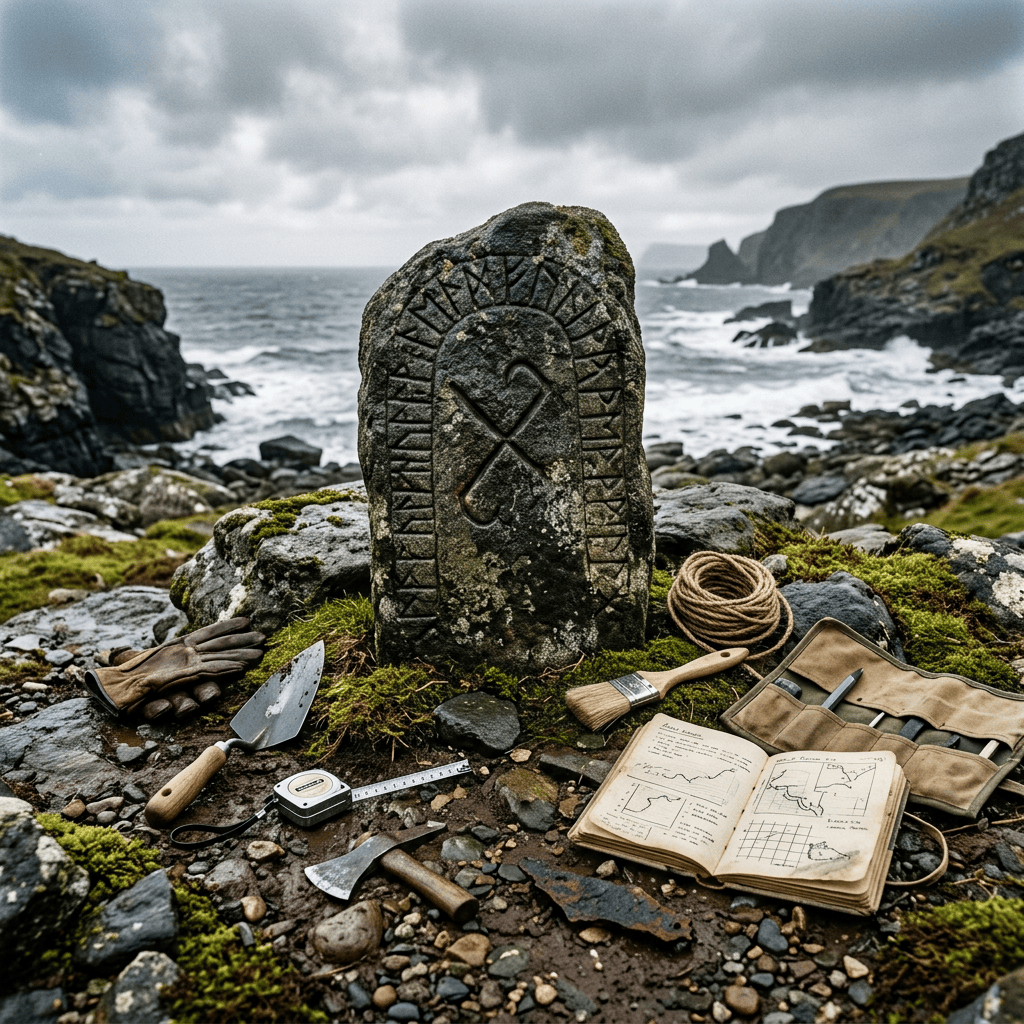
While mainstream historians trace the Templars through papal bulls and royal charters, forensic geologist Scott Wolter and other researchers have pointed to physical inscriptions—specifically a runic character known as the Hooked X—as potential archaeological evidence of Templar survival and transatlantic voyages.
The symbol resembles a standard capital “X” with a small hook attached to the upper right arm. In primary medieval Scandinavian runic manuscripts—most notably the late-thirteenth-century Codex Runicus (AM 28 8vo, preserved at the Arnamagnæan Institute in Copenhagen)—this character appears as a dotted or hooked variant of the ar / a rune, used by medieval scribes and Cistercian monks (the monastic order whose abbot, St. Bernard of Clairvaux, co-wrote the Templars’ original Latin Rule at the Council of Troyes in 1129). Researchers studying Templar iconography argue that initiated stonemasons, Cistercians, and fugitive Templars adopted the Hooked X as a coded guild and lineage signature.
Key North American Archaeological Sites Linked to the Symbol
Proponents of the Templar-voyage theory point to a trail of stone inscriptions and architectural structures along the eastern seaboard and inland waterways of North America:
- The Kensington Runestone (Douglas County, Minnesota). Unearthed in November 1898 on the farm of Olof Ohman, this 202-pound slab of greywacke bears a nine-line front inscription and three-line edge inscription dated to 1362, describing an exploration party of “8 Goths [Swedes] and 22 Norwegians” traveling west from Vinland. The Hooked X appears 22 times in the carving. While mainstream runologists and linguists widely classify the stone as a 19th-century creation due to modern Swedish grammatical forms and vocabulary, petrographic and geological weathering studies conducted on the stone’s mica and pyrite inclusions have kept the authenticity debate active among independent researchers.
- The Narragansett Runestone (North Kingstown, Rhode Island). Discovered along the tidal shoreline of Narragansett Bay in 1984 (and documented in state archaeological files), this 2.5-ton glacial boulder features two horizontal lines of carved runes that include the Hooked X. Researchers argue it functioned as a fourteenth-century medieval boundary or land-claim marker placed by European mariners centuries before Columbus.
- The Newport Tower (Newport, Rhode Island). Standing 28 feet tall in Touro Park, this circular stone structure supported by eight Romanesque arches bears a striking architectural resemblance to twelfth-century Templar round churches in Europe—specifically the Charola rotunda at Tomar in Portugal and the Temple Church in London. In 1993, radiocarbon testing of mortar samples conducted by the Danish National Museum and University of Aarhus yielded calibrated dates ranging from the fifteenth to seventeenth centuries, while independent researchers note its astronomical alignments and medieval English/Scottish unit measurements point to a pre-Columbian European origin—potentially built by Templars or voyages linked to Henry Sinclair, Earl of Orkney, sailing west from Scotland around 1398.
- Spirit Pond Runestones (Phippsburg, Maine). Three small inscribed metamorphic stones discovered near Popham Beach in May 1971 by Walter Elliott feature medieval runic characters, numerical dates corresponding to 1401, a map outline, and Hooked X variants, which researchers link to the same fourteenth- and fifteenth-century North Atlantic maritime network.
Separating Physical Evidence from Legend
To mainstream archaeologists and historians, the Newport Tower is a mid-seventeenth-century colonial windmill built by Rhode Island Governor Benedict Arnold, and the North American runestones are nineteenth-century artifacts rather than medieval Templar relics. Yet to independent researchers, the geographic alignment of these sites—combined with documented Portuguese maritime charters under the Order of Christ and Scottish-Orkney naval traditions—suggests that when the Knights Templar vanished from France in 1307, their navigational knowledge and sacred symbols did not disappear with them. Instead, they sailed outward, leaving behind a trail in stone that continues to spark investigation centuries later.

