
BY MARILYNN HUGHES
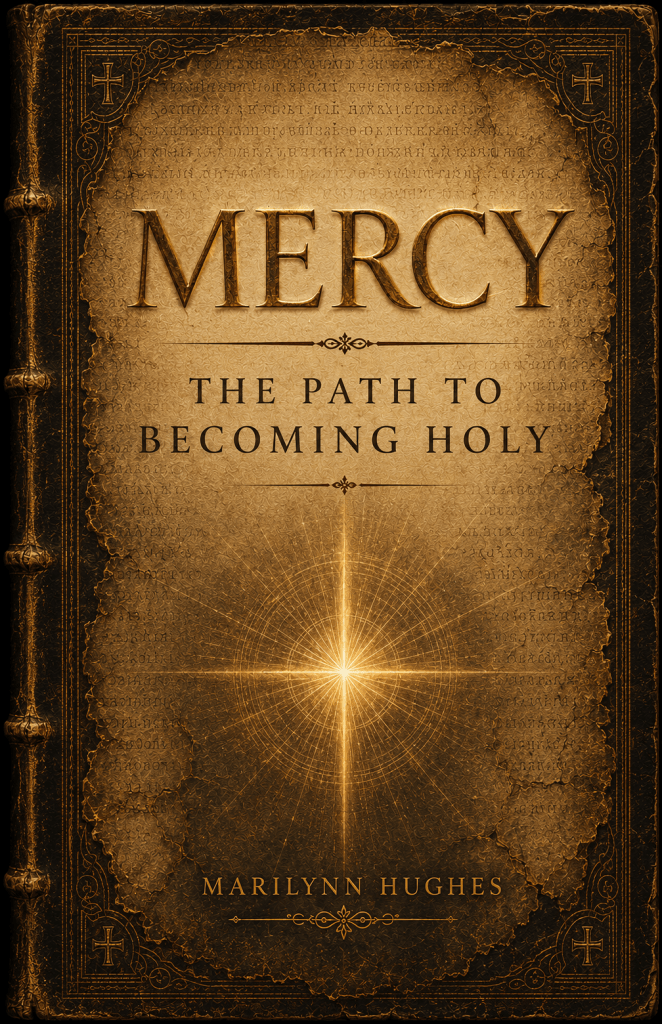
Mercy: The Path to Becoming Holy
By Marilynn Hughes
There is a power that does not destroy in order to rule. It does not overwhelm the soul to break it. It does not withdraw when the soul is weakest. It remains. This power is God’s mercy.
In Mercy: The Path to Becoming Holy, mercy is revealed not as sentiment or abstraction, but as a living divine force that enters the deepest places of human struggle—where identity has hardened, where hope has collapsed, where suffering has become internalized and silent.
This is not a philosophy of consolation. It is a testimony to transformation.
Across the movements of this inquiry, the soul is shown in its many states: bound by inner chains it no longer recognizes, lost within spiritual darkness, pressed by despair, and burdened by suffering it cannot resolve through will alone. And yet, in each condition, mercy is present—not as explanation, but as presence; not as theory, but as action within the soul itself.
Mercy does not wait for the soul to become worthy. It moves first.
It loosens what has become fixed. It enters what has become closed. It remains where the soul believes it is beyond reach. And through this quiet, unwavering presence, something begins to change from within: identity softens, perception opens, despair loses final authority, and what once felt unchangeable begins to yield.
In this vision, holiness is not presented as distance from human weakness, but as the transformation of the soul through sustained contact with divine mercy. Freedom is not escape from life, but liberation within it. And love is not distant ideal—it is the active power shaping reality from within.
Ultimately, this inquiry invites the reader into a single realization that changes everything:
Mercy is not something the soul reaches toward.
It is the divine power that reaches into the soul—and does not let it go.
Reviews
“God’s Mercy Remains—It Never Leaves You
‘Mercy: The Path to Becoming Holy’ has opened my eyes and awakened my heart to the power of God’s mercy. Whether you live—or have lived—with the burdens of abuse, sin, shame, guilt, hopelessness, despair, or feeling abandoned by God, or have ever felt unworthy of God’s mercy, this book is for you. I assure you: you are not alone. I have carried these burdens, and this book found me and met me at the point of my need.
To readers who are looking forward to reading this book, I want to share this: prepare to have your soul uplifted by the truth presented within its pages. It has deeply touched me, and I believe it will do the same for you.
Before purchasing this book, I often asked myself, ‘Am I worthy of God’s mercy?’ After reading it, I found the answer in these passages:
‘Mercy is stronger than despair. Mercy is greater than fear. Mercy reaches farther than darkness. And no soul is beyond its reach.’
‘The soul under the weight of guilt often believes it must first become worthy before mercy can approach. But mercy does not wait for worthiness… Mercy meets the soul inside the weight itself. Not after. Not beyond. But within it.’
I really needed to read that. Yet I still wondered about the times when I felt unloved, lost, and abandoned by God. As I continued reading, I learned that mercy was present during those times, too:
‘Mercy remains… It is a constant movement of Divine Love toward the soul… Because even in abandonment, something within the soul continues to long for mercy. And longing itself is already a response to presence. It is the memory of being called. The echo of being loved.’
As I read those words, I could truly feel them for the first time, and I resonated deeply with everything on the page. Still, something remained hidden—something buried deep within me that kept me from fully believing I was worthy of receiving God’s mercy. I recognized it when I read this:
‘The soul may still believe in God, but it no longer believes in being held by God.’
‘A soul may not feel held. But it is still held. A soul may not feel sought. But it is still sought. A soul may not feel known. But it is still known.’
Because of the burdens of my soul and my past, I had not felt truly worthy of being held by God, or worthy of His Divine Love and Mercy. Now, through tears, I know that I am loved, held, worthy, and known—and that the power of God’s mercy remains. It will never leave me, and neither will He.
This book has brought healing to my soul. Let it do the same for you. I loved it and highly recommend reading it. Mercy remains.” – Windsong, Austin, TX, USA


