
By Marilynn Hughes
In my previous post, we explored why modern out-of-body travelers must ground their journeys in the writings of the ancient sages rather than wandering the infinite alone [theological baseline]. But this universal language of direct spiritual experience is not a mere academic theory. It is a living ledger.
When we place modern, firsthand astral journals side-by-side with texts written by cloistered monastics, desert ascetics, and ancient rishis separated by centuries, the map of human consciousness becomes undeniably clear. Here are the profound case studies where modern exploration directly intersects with the timeless architecture of the soul.
1. The Geometry of the Spheres: St. Teresa of Avila’s Interior Castle
In contemporary exploration, travelers often report moving through complex, interlocking celestial structures, concentric rings of light, or luminous rooms that seem to possess an inherent spiritual intelligence. Without context, these spaces can seem disorienting.
Yet, in the 16th century, St. Teresa of Avila was given a brilliant structural blueprint of this exact phenomenon in her masterpiece, The Interior Castle. She described the soul as a magnificent, translucent diamond or crystal castle containing seven distinct mansions, each concentric ring moving closer to the central King or Godhead. When a modern traveler experiences the shifting geometries of the higher causal planes, they are not discovering a new realm—they are navigating the very mansions Teresa mapped out through her own deep contemplative ecstasies.
2. The Functional Geography of the Astral: Emanuel Swedenborg
Modern travelers frequently observe that the non-physical realms are not a chaotic void, but a highly structured, vast reality complete with societies, schooling facilities, libraries, and distinct habitations where souls gather based entirely on their internal state.
The 18th-century scientist and mystic Emanuel Swedenborg spent decades detailing this exact non-physical landscape in works like Heaven and Hell. He mapped out the immense, objective reality of the spiritual world, explaining that communities in the afterlife are perfectly segregated by spiritual affinity and frequency. Swedenborg noted that souls naturally drift toward the realms and groups that match their dominant internal love. A modern explorer visiting a heavenly school or learning center is directly validating Swedenborg’s firsthand accounts of the organized, educational nature of the paradise spheres.
3. Deceptive Frequencies and Bright Illusions: The Tibetan Bardo
A common danger in out-of-body travel is being lured into deceptive, lesser regions by thought-forms or entities that coat themselves in a superficial, dazzling brightness. Novice travelers often mistake any bright astral light for the highest heaven.
This exact psychological and spiritual trap is explicitly warned against in the Bardo Thodol (The Tibetan Book of the Dead). The ancient text instructs the consciousness moving through the intermediate states to bypass the dull, seductive, colored lights that appeal to the unpurified ego’s attachments. Instead, the traveler is urged to merge directly with the blinding, clear, and uncompromising Primary Light of the divine. Both modern OOBE journals and ancient Tibetan masters agree: discernment of light frequencies is critical to avoid being ensnared by lower astral illusions.
4. The Burning Away of Identity: St. John of the Cross
Advanced travelers moving toward true transcendence often report a grueling phase where they feel completely stripped of their spiritual ego, abandoned by the light, or crushed by an intense, dark, internal pressure that forces them to surrender all control.
This precise mechanical clearing was systematically mapped by the 16th-century Spanish mystic St. John of the Cross as the Dark Night of the Spirit. He described it not as a psychological depression, but as a profound metaphysical operation where the Divine Light acts like a physical fire on a damp log. Before the log can ignite and become light itself, the fire must sweat out the dense moisture, turn it black, and burn away its impurities. When a modern soul experiences this agonizing spiritual compaction, they are experiencing the exact purgative furnace St. John mapped out to prepare the soul for absolute buoyancy.
5. The Ninefold Order of Heaven: Pseudo-Dionysius the Areopagite
Explorers who break through the lower astral planes and touch the highest celestial regions frequently encounter massive, organized hierarchies of light beings who operate with unified, mathematical precision. These angelic intelligences do not just emit light; they communicate pure law, harmony, and cosmic structure.
This exact multi-tiered majesty was decoded in the 5th century by Pseudo-Dionysius the Areopagite in his seminal work, The Celestial Hierarchy. Dionysius mapped the heavenly host into three distinct triads containing nine total orders (Seraphim, Cherubim, Thrones, Dominions, Virtues, Powers, Principalities, Archangels, and Angels). He explained that each rank serves as a lens, filtering and step-down transmitting the pure, blinding energy of the Godhead so lesser creations can absorb it without dissolving. When a modern traveler stands before overwhelming choirs of light and experiences structured, descending layers of cosmic majesty, they are directly observing the celestial hierarchies Dionysius cataloged centuries ago.
6. The Wheel of the World: St. Hildegard von Bingen
In deep out-of-body states, travelers sometimes behold the entire material universe from a massive cosmic distance, seeing the earth and stars woven into a giant, living, breathing wheel of interlocking rings, fires, and currents driven by a singular Divine Mind.
The 12th-century German visionary and polymath St. Hildegard von Bingen was granted this precise structural perspective, which she recorded and illuminated in her theological masterwork, Scivias. She saw the cosmos as a vast, egg-shaped structure enclosing a cosmic wheel of fire, wind, and ether, completely permeated and sustained by the living energy of God. Hildegard’s detailed diagrams of these moving celestial matrices offer the exact same geometric framework that modern mystics encounter when their consciousness expands far enough to witness the macrocosmic engine of creation.
7. The Merkabah Chariot Vision: The Prophet Ezekiel
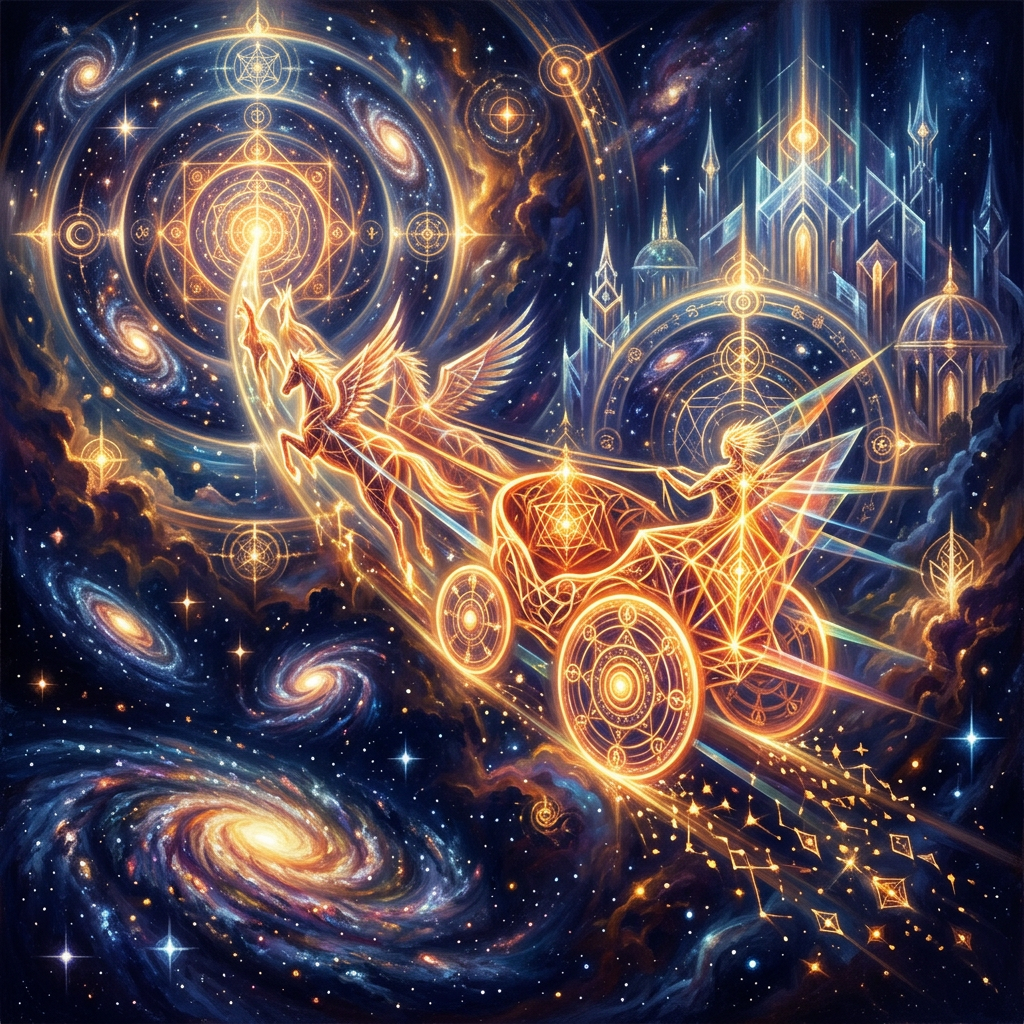
The transition from ordinary waking awareness into high mystical ecstasy is often accompanied by intense structural auditory and visual phenomena: the roar of a great rushing wind, a flashing fire enfolding itself, and the appearance of complex, spinning gyroscopes or “wheels within wheels” glowing like burning brass.
This is the exact structural choreography of the Merkabah (Chariot) Vision recorded by the Prophet Ezekiel by the River Chebar. Ezekiel described a whirlwind coming out of the north, a great cloud with a fire infolding itself, and the Ophanim—living wheels within wheels whose rims were full of eyes, moving with lightning speed wherever the spirit directed them. In modern OOBE travel, touching the intense vortex of the Merkabah or encountering these spinning, multi-dimensional geometric vehicles is a direct participation in the ancient prophetic science of the Chariot ascent.
8. The Axis of the World and Spirit Guides: The Native American Medicine Wheel
When separating from the physical body, travelers frequently experience a sudden, radical shift in perspective where the cosmic landscape aligns along four distinct cardinal directions, each possessing its own unique energetic current, color, and spiritual guardians. During these flights, travelers are often met by ancestral guides or animal archetypes who assist them in navigating the transitions between worlds.
This is the exact metaphysical architecture of the Medicine Wheel and the Hanbleceya (Vision Quest) practiced across Indigenous North American traditions, such as the Lakota. The Medicine Wheel represents the sacred hoop of the universe, mapped onto the four directions (North, South, East, West), each representing a different stage of spiritual development, an element, and a specific animal manifestation of the Great Spirit (Wakan Tanka). To seek a vision, the initiate completely detaches from worldly comforts, isolates in nature, and enters an altered state where they leave the body to communicate directly with the spirit world. Modern explorers who find themselves traveling along clear directional axes and encountering protective spiritual guides are directly engaging with the timeless cosmic geometry anchored by Native American medicine keepers for millennia.
9. The Ecstatic Dissolution and Flight: Jalal al-Din Rumi and Sufi Mysticism
During advanced ascents, travelers often experience the final, soaring breakthrough as a state of pure intoxication, love, and ecstatic dissolution. The boundaries of the ego do not just fade—they explode into an intense yearning to be consumed by the Divine Beloved. To achieve this flight, the traveler must completely “die to the self” while still inhabiting a living frame.
This is the exact operational reality described by the 13th-century Persian Sufi master and poet Jalal al-Din Rumi. In the tradition of Islamic Mysticism, Rumi wrote tirelessly of the Fanā—the annihilation of the ego in the presence of God—and famously proclaimed, “Die before you die.” He described the human spirit as a bird trapped in the cage of physical density, desperate to shatter its boundaries and fly back to its true home in the celestial spheres. Rumi’s accounts of the soul whirling, dancing, and effortlessly shedding its earthly weight through pure, ecstatic devotion provide the precise spiritual vocabulary for modern travelers who experience out-of-body travel not as a mechanical exercise, but as a burning, breathless return to Divine Love.
10. The Seven Valleys of Ascension: Baha’u’llah
As the traveler ascends deeper into the inner worlds, the journey transitions from structural scenery into distinct states of being or internal landscapes. The soul must cross specific spiritual thresholds where its fundamental perception of reality is utterly transformed.
In The Seven Valleys, the prophet Baha’u’llah explicitly mapped out this mystical topology of the soul’s ascension toward the Divine. The traveler must sequentially cross the Valley of Search, the Valley of Love, the Valley of Knowledge, the Valley of Unity, the Valley of Contentment, the Valley of Wonderment, and finally, the Valley of True Poverty and Absolute Nothingness—where the individual self is utterly annihilated to find life everlasting. Modern out-of-body travelers who experience their journey not merely as moving across space, but as climbing through progressively refined, testing psychological and spiritual domains find their experiences perfectly charted in this classic of Middle Eastern mysticism.
11. The Garment of Light and Cosmic Palaces: The Jewish Zohar
In deep mystical ecstasies, travelers often report encountering majestic celestial palaces (Hechalot) of glittering glass and light, or finding their non-physical form enveloped in a literal woven garment of blinding luminescence that mirrors the spiritual purity of their character.
This is the core visionary framework of Jewish Kabbalah as preserved in the Zohar (The Book of Splendor). The Zohar details that when the soul ascends to the upper chambers during life or after death, it must be clothed in a Zilchā d’Nhorā—a holy “garment of light” or aura constructed entirely from the spiritual deeds and purity it cultivated on Earth. Without this lightweight vestment, the soul cannot endure the blinding brilliance of the upper palaces. Modern explorers who observe the shifting density of their own spiritual clothing or stand before awe-inspiring crystalline architectures are directly witnessing the Hechalot structures mapped out by centuries of Jewish mystics.
12. The Void of Absolute No-Mind: Zen Buddhism
Advanced practitioners who reach the pinnacle of consciousness exploration sometimes step out of all forms, landscapes, and entities entirely, entering an absolute, unmanifest Void. This is not a state of dark oblivion, but a baseline of boundless, radiant awareness completely empty of individual self-identity.
In Zen Buddhism, this ultimate expanse is understood as Śūnyatā (Emptiness) or the realization of Mu (Nothingness). It is the state where all dualistic concepts drop away completely, leaving only the pristine, mirror-like nature of original mind. When a modern out-of-body explorer stops running through the astral planes, strips away all thought, and discovers that their true nature is a boundless, unattached space, they are touching the exact ontological reality that Zen masters cultivate through decades of rigorous zazen.
13. The Formless Stream of Cosmic Flow: Taoism
When the traveler operates from a state of total alignment, they cease forcing their movements through personal willpower. Instead, they glide effortlessly through the cosmic spaces, swept along by a hidden, non-physical current that naturally routes them to where they need to be.
This is the central metaphysical principle of Taoism, defined by Laozi as Wu Wei (effortless action or flowing with the Tao). The Daodejing explains that when a practitioner surrenders their individual ego, they align with the primordial stream of the universe. In the non-physical realms, any attempt to use the forceful, rigid will of the lower self causes immediate stagnation or descent. Modern explorers who master the art of relaxed, floating navigation discover the absolute law of the Tao: by doing nothing from the ego, everything is effortlessly accomplished by the spirit.
14. The Chinvat Bridge and the Chariot of Light: Zoroastrian Avesta and Pahlavi Texts
A consistent experience in out-of-body travel is the crossing of a sharp threshold or bridge that separates the dense earth plane from the realms of pure light. If the soul is heavy, the crossing feels terrifying and narrow; if the soul is light, the bridge transforms into a wide, luminous highway traveled alongside radiant, protective entities.
This exact transitional architecture is systematically laid out in the Zoroastrian Avesta and Pahlavi texts (such as the Ardā Wirāz-nāmag, an ancient Persian account of an out-of-body journey). The texts describe the Chinvat Bridge, a metaphysical crossing guarded by spiritual forces. For the unpurified soul burdened by vice, the bridge narrows to the width of a razor blade, causing them to fall into the lower abyss. For the purified soul, the bridge becomes leagues wide, and they are met by a beautiful maiden (Daena, the personification of their own pure conscience) who guides their radiant chariot of light into the endless celestial stars.
15. The Weightless Transcendence of the Jiva: Jainism
In deep mystical states, the soul realizes that its natural state is one of absolute upward movement. When it is completely stripped of physical and astral influences, the spirit does not wander horizontally—it shoots vertically into the highest possible pinnacle of the universe.
In Jain Cosmology, this exact dynamic defines the liberation of the Jiva (soul). Jainism teaches that the soul is naturally weightless and buoyant, but it becomes weighted down by karma, which they view as literal, subtle material particles that stick to the soul through passions and vice. When all karmic matter is systematically dissolved through the fires of purification, the soul achieves Siddhashila—instantly rising to the absolute apex of the cosmic universe, where it abides forever in infinite knowledge, bliss, and power. Both modern OOBE ascents and ancient Jain teachings confirm that true spiritual freedom is a matter of shedding cosmic weight.
16. The Koshas and the Ascension of the Rishi: Hinduism
Finally, travelers frequently observe that they do not possess just one body, but multiple cascading layers of consciousness—peeling back an earthly form, an emotional vehicle, and a geometric mental casing before touching the core spirit.
This precise anatomy of consciousness is the absolute foundation of Hinduism, explicitly mapped in the ancient Upanishads as the doctrine of the Koshas (the five sheaths of the soul). The text maps consciousness moving from the Annamaya kosha (physical body) through the Pranamaya kosha (vital breath), the Manomaya kosha (mental sheath), the Vijnanamaya kosha (wisdom sheath), and ultimately into the Anandamaya kosha (the body of pure bliss). In the Yoga Sutras of Patanjali, the practice of Pratyahara and Samadhi allows the Rishi to systematically disentangle the soul from these sheaths, achieving safe, high-flying out-of-body transcendence (Siddhis). Modern explorers who experience moving through different layers of their own energy bodies are validating the exact multi-dimensional anatomy charted by the ancient Vedic sages.
The Unbroken Map
These sixteen case studies prove that the spiritual path does not change across generations, cultures, or geographic boundaries. The landscapes you navigate when your consciousness detaches from the flesh have been walked, charted, verified, and preserved by an unbroken lineage of humanity’s great contemplatives [historical sources]. By studying their records, you inherit their armor, their maps, and their ultimate victory.

